Pages

Wednesday, 19 August 2015

Doris - Simulation, storage and sustainability (4) - You have to do both

Doris is a computer simulation of household energy consumption designed to explore the relationship between storage and the consumption of energy from sustainable sources.  It exists only in the imagination and has no physical reality.  A description can be found here:
This page also has links to related posts.

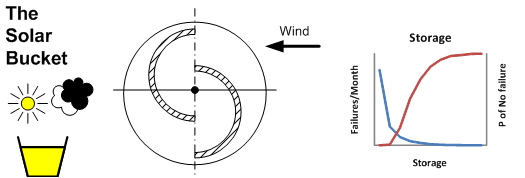
The current version of Doris is the third attempt to explore a sustainable energy system.  The first took place in 2007/8 which became known as the Solar Bucket.  This was simply a 4 watt solar panel connected to a small lead acid battery, during the day the panel charged the battery which was then used to support some form of load overnight, the most useful being an LED light.  The Solar Bucket worked OK during summer and less well during winter.  One of the lessons of this exercise was the effect of clouds on solar devices.  The second attempt was in 2013 which used the output of an imaginary wind farm to charge a bank of Ni-MH cells, if the make believe wind farm did not produced enough electricity, it kept itself alive using an old mobile phone charger.  This version ran erratically during the winter of 2013 and again in the spring of 2014.  The behavior of this system can be summarized as alternating between a few days on wind power and a few days hanging on the phone charger.

I took away two lessons from this experience, first that messing with hardware is a fun, but a slow way to explore a concept and a software emulation would be more efficient (and cheaper).  Secondly, for the location where I live which has a temperate maritime climate (Koppen type Cfb), a system which attempted to minimize dependency on conventional sources would probably need to utilize both wind and solar sources.

The graphs below show the result of three runs of Doris using historic data for 2011 using the base configuration with 10 kwh of storage and an annual load of 2,500 kwh.  In the first, the system has access to both wind and solar sources.  In its current form, Doris gives priority to solar energy, so the combined graph is biased towards solar and a different set of rules would give a different outcome, but it gives an indication of the direction of travel.

In this configuration, the peak demand for conventionally generated electricity is approximately 30% which can take place more or less anytime except summer.  When access is restricted to wind energy alone, the peak demand for conventional energy rises to 55% in summer with significant amounts being needed throughout the year.

In the solar only configuration, the dependency on conventional sources rises to 90% in winter, but less than 10% in summer.


As with all simulations, the output reflect decisions about the inputs.  for example, different results could be obtained by increasing the access to solar energy.  This would provide a surplus for export during the summer months with less dependency on conventional sources in winter.  The base configuration for Doris is loosely based on a 1 kw solar array (four 250 watt panels) and 1 kw of wind generating capacity.  The location of the wind capacity is assumed to be at a prime location.

History: originally posted on 19-Aug-2015 and revised 24-Nov-2015.

Images: blog_116


Monday, 17 August 2015

Doris - Simulation, storage and sustainability (3) - Storage Sensitivity

Doris is a computer simulation of household energy consumption designed to explore the relationship between storage and the consumption of energy from sustainable sources.  It exists only in the imagination and has no physical reality.  A description can be found here:
This page also has links to related posts.

The base configuration for Doris is a household which consumes 2,500 kwh/year.  It is connected to the grid and has access to electricity from conventional, wind and solar sources.  In the base configuration (config 3) there is 10 kwh of storage.  Follow the above link for a more detailed description.  Incorporating storage into the household energy economy makes it possible to get a better match between the availability of electricity from weather dependent sources and the regular pattern of demand which comes from sleeping, work, college and preparing meals.

The proportion of sustainable energy consumed by a household from the grid is roughly 10 - 15% but on any given day this might vary from zero to 20% depending on the season and the prevailing weather. If a household has an element of storage, this might increase to 50 - 70%.  The Doris model assumes that the household has direct access to wind and solar sources, thus the output is not comparable to data from the national grid.

Obviously the the greater the amount of storage the better, but there are also economic constraints and this series of runs was intended to see where the law or diminishing returns set in with the objective of defining the base configuration.  As with any simulation, the output is determined by the assumptions used in the model and as there are many combinations, the graphs below only indicate the direction of travel rather than precise forecasts.

 The rules used by the Python 2.7 code give precedence to solar sources, if no solar generated electricity is available it then checks to see if there is any which has come from a wind farm, if insufficient power is available, the demand is met from storage and when this is exhausted if falls back on conventional sources from the grid.  Any surplus sustainable energy is used to recharge the storage.

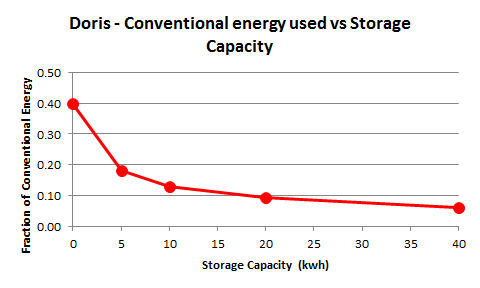
The storage capacity affects the consumption of wind and solar sources differently.  The availability of solar sources is based on a 24 hour cycle with significant variations resulting from sun-earth geometry and cloud cover, thus diminishing returns set in with around 5 kwh of storage.  Wind energy tends to come in pulses a few days apart and the consumption of wind generated electricity increases with increasing storage.

The graph below shows that the proportion of energy from conventional sources falling as the storage capacity increaes.

Bases on these runs, the storage capacity for the base configuration was arbitrarily set at 10 kwh.  This is thought be a reasonable balance between cost and performance and there are available products for this capacity.

Note

This is a simulation, not real life.  This post was originally published on 17-Aug-2015 and substantially revised on 23-Nov-2015.


Friday, 14 August 2015

Doris - A thought experiment in progress (2) - Energy Delivery

Doris is a computer simulation designed to explore the use of sustainable energy by a typical household.

The post which describes the background to the project, also contains links to related posts.
The core functionality of Doris is the facility to make estimates of the output of wind and solar generators using aviation weather reports (Metars).  The version running on the Raspberry Pi runs the base configuration and uses a live feed from NOAA, but the same code can be fed with historic data which makes it possible to explore a range of configurations and scenarios.

Wind and solar sources are weather dependent energy sources subject to seasonal variation, this distinguishes them from fossil/nuclear plant whose output is controllable.  Storage and diversity helps to match supply and demand.

The first graph shows the estimated breakdown of energy sources for a configuration with approximately one day's storage.  There are several things happening in this graph, the first is the seasonality of wind and solar sources.  Solar works well during the summer months, but makes little contribution during the winter.  Another issue is the constraints on the amount of energy that the system can import, these have been set at low levels and may restrict the amount of energy that can be stored.  During the winter months, the system falls back on to the grid more than is desirable. This is partly due to the differences in the pattern of delivery from wind and solar sources.


Wind energy comes in pulses at intervals ranging from a couple of days to a fortnight.  In winter during the calm periods, Doris maintains it's imaginary load from the grid.
In contrast the delivery of solar energy is regular, within a given month the greatest variation comes from variations in the nature of the cloud cover.
A relatively small amount of storage will provide a reasonable match between supply of solar energy during the summer and the load it is maintaining.  It is probable that a much larger storage capacity is needed to meet a constant load from wind sources.

The next step is to run a sensitivity analysis on the amount of energy taken from the grid and the storage capacity of the system.

Thursday, 13 August 2015

Doris - A thought experiment in progress (1) - Background

Doris is a computer simulation designed to explore the use of sustainable energy by a typical household.

Doris lives in a simplistic and imaginary world, it poles weather reports from a randomly selected airfield which is near an imaginary wind farm. it has access to some fictitious local solar panels and thinks it is connected to the national grid. The meteorological data is used to estimate the wind and solar power that might be available. There is some storage built into the system and when more energy is available than is required to meet the load, it used to charge batteries. When the wind does not blow and the sun does not shine, the load is supplied from stored energy and when that is consumed it falls back on conventional sources from the national grid.  Energy from the wind farm is supplied from the grid whilst it is assumed that the solar panels are located on the consumer's site or on a local grid.

Doris - What is being simulated
It is the result of two activities:
  • Having spent much of life in the oil and gas industry, I felt the need to explore sustainable sources.  This included the academic study of things like wind speed distributions, climate, sun-earth geometry and the effect of clouds on solar irradiance.  There was also a practical element which included a 4.5 watt PV panel, a lead acid battery and an LED light known as the Solar Bucket plus a few cycle rides around the town and surrounding countryside with a simple wind speed meter.
  • In 2007, before the financial crisis, rooftop PV panels and wind turbines were becoming available and I became curious to to know if it was possible to economically reduce household reliance on the grid by using these products.
Both of these efforts came to the same conclusion, that increasing the proportion of household energy coming from sustainable sources was a challenge.  Some caveats are necessary before making any conclusions:
  • Economics are important, any alternative to fossil fuels must deliver the same benefits for a comparable cost, if it does not, no one will adopt it.
  • The technology is the key technology because it separates production and consumption into two separate processes.
  • Much discussion of sustainability focuses on generation, yet managing and reducing consumption is, maybe, more important.  Sustainability is easier to attain if the demand is low.
  • The nature of a sustainable solution is dependent on the climate in which it is installed, thus the experience of one country may not be relevant to another.  Solar PV might work well in the deserts of Arizona, but less so in the highlands of Scotland where wind turbines are a more attractive option.
The conclusions I came to for a location in the south of England were:
  • Solar PV works well in summer, but not in winter.  On a sunny summer day, the cumulative GHI might be 8 kwh/m2, whilst on an overcast December day it can be less 1 kwh and that is the time of year is when energy consumption is at a peak.
  • The most effective way of generating energy from the wind is from industrial scale wind turbines located in optimum locations such as onshore ridges and offshore.
  • Both solar and wind are discontinuous sources of energy, the sun does not shine at night and wind energy comes in pulses which can be several days apart.
  • Wind and solar sources will not be able to fully displace fossil fuels in the short term but the proportion from sustainable sources can be increased.
A system which could mitigate some of these issues for a typical household might look like this:
  • Focus energy consumption and management on storage with a capacity of 5 - 10 kwh.
  • Only draw energy from the grid when equivalent amounts of energy from sustainable sources are being fed into it.
  • Ensure that there is access to both wind and solar generating capacity.
  • Use energy generated from conventional sources only when the storage is depleted and sustainable source are not available.
Such a scheme might increase the proportion of sustainable energy consumed by a typical house to around 70%.

Doris is software which can be modified to explore ideas without the expense which would be incurred by working with expensive real things.  Several configurations and scenarios have been run and these are described in the following posts:
Simulation is not real life, so the results should be treated as a possible direction of travel rather than detailed predictions.  At the time of writing, these posts are being edited and are subject to change.

Doris can runs in two modes:
  •  On a Raspberry Pi with live data from NOAA via an internet connection.  The Pi runs the base configuration and is capable of uploading graphics to a shared server.  In this case, the behavior of the software has some relation to the weather on the other side of the window.
  • Much the same code runs on a laptop using historic data from an SqLite database, this allows different scenarios to be run against the same weather data or similar configurations with different weather data.
   The data flow looks like this:

Doris - Data flow
Doris is work-in-progress. The first iteration used an old laptop, an interface card and a home brewed bank of Ni-MH cells, the computer obtained weather data from the internet and made decisions which it implemented using the interface card and tried to maintain a small load without recourse to the grid (in reality a discarded mobile phone charger). Whilst this was both entertaining and instructive, it was an inefficient way of exploring the concept, not least because of the energy overhead of the aging laptop and the risks associated with my dubious knowledge of power electronics.

Doris - The first attempt, a second would be nicer
Whilst there are significant technical and commercial issues associated with implementing a "real" version of Doris, it is economics which presents the greatest challenge.  Whilst the virtual world of Doris has the potential to reduce emissions by maximizing the use of energy from sustainable sources, the economics don't look good. The retail consumer has two pricing options, either a single tariff or something like Economy 7 which offers electricity for around 7 p/kwh in the wee small hours and at least twice that during the day. Solar generated electricity is almost by definition can't be bought off peak because the sun does not shine at night. For this scheme to be viable there needs to be some innovation in the energy market which gives producers are reasonable rate of return and reduces the reliance on fossil/nuclear sources. One possibility is for users to have a stake in the ownership of  generating capacity rather than buying its output at a unit cost.

The base configuration of Doris was chosen such that the installed cost of a non-imaginary system would be within sight of £5k, this is summarized as:
  • Annual energy consumption: 2,500 kwh (approx. 7 kwh/day)
  • Storage capacity: 10 kwh
  • Solar generating capacity: 1 kw
  • Wind generating capacity 1 kw
The methodology for estimating solar irradiance under a cloud sky is evolving and is part of a separate project, the method used for Doris has a pragmatic element to it and hopefully will evolve.

Some of the work from which Doris originated is described in these posts:
Who was Doris?

I first heard the expression "I'm Doris, the goddess of wind" from an old bloke I worked with in a sheet metal factory.  There's a lot of wit in factories along the lines of "The water is safe to drink because it's been passed by the management".  The Doris quip stayed with me and then someone invented the internet and Jimmy Wales started Wikipedia.  This tells me that it was the catch phrase of Douglas Byng who is described as an English comic who trod the boards before and after the second world war.  As many software titles get subverted, it seemed a good idea to start with something that was already ambiguous.

This post was revised on 03-Nov-2015


Saturday, 18 July 2015

Lead was all around

Hancock's "Half Hour" and "Steptoe and Son", both comedy series written by Galton and Simpson in the 1960's and 70's had more than one reference disreputable characters stealing lead from roofs.  I am reliably informed that one of the murder weapons in the game of Cluedo is a length of lead pipe.   If there was a lot of lead in light entertainment, there was even more of it in Victorian and Edwardian buildings.

In the last couple of years I've more or less become my own builder and whilst renovating my house have come across a lot of lead in one form or another.  To the best of my knowledge, lead is only used for roofs and flashing in modern structures.

Lead roofing
The attraction of lead as a building material is that it is malleable and does not corrode.  From a half remembered conversation with a retired builder, there was once a specialist trade of lead workers whose principle skill was to beat lead sheet into the complex shapes drawn by architects.  The term plumber (which means lead worker) was reserved for people who worked with lead pipe.

At the time our house was built, all the plumbing was lead tubing, working with this stuff would have been hard, a 10 metre run of pipe would have been heavy and it probably needed two men to install, one to do the bending and another to support the pipe until it could be secured to the structure.  Relative to modern plastic plumbing, forming joints and connections would have been a lengthy and skilled task in which the pipe and solder(?) had similar melting temperatures.

A tee junction in lead piping
I was surprised to find lead had been used a sheath for electric cables which might have been installed around 1911.  I'm guessing, but one of the problems with early electric cabling might have been water induced breakdown of insulation.  Whilst lead was not an obvious choice of sheathing material, it would have provides some protection against water.

Lead Sheathed Cable
One of the attractive features of Victorian and Edwardian houses is stained glass windows.  These are segments of glass held together with I-section lead piping.  Over time stained glass windows can sag if they are exposed to the sun and fatigue if they are mounted in doors, thus you get a bill for restoration approximately every hundred years.


Apart from drafts rattles, sash windows are an attractive feature of Victorian houses, concealed in the frames are four counterweights, in the case of our house, there is more than quarter of a ton of cast iron in the windows, however, in grander properties with large windows, lead was used for the sash weights.

Lead would also have been present in accumulators which were used for door bells and other signalling devices and later to heat the filaments in valve radios.  Local shops offered to charge up the accumulators, maybe for a shilling, which was a very expensive way of buying electricity.

Various lead based materials were in regular use, the most common was paint.  Lead paints had a reputation for durability and the pretense of lead implied a premium product.  Whilst lead is no longer used in paint, its previous large scale use makes it necessary to take precautions when sanding down old doors and window frames to avoid inhaling the dust.  Another one was "red lead" which was a sealing compound used with iron and brass pipe fittings.

Until relatively recently tetra-ethyl lead was used in petrol to prevent "pre-ignition" and was often referred to as an "anti-knocking" additive.  The engines in early cars were large had low compression ratios, for example the Model T ford had a swept volume of 2900 cc and a compression ratio of around 4.  When lead as added to petrol, compression ratio could be increased to around 7 or 8 which increased the efficiency of the engine allowing the size of engine to be reduced for a given output.  At the end of the 1930s small cars typically had 1,000 cc engines.  At one time petrol was sold according to with its octane rating denoted by a number of stars and the higher the octane rating, the higher the price and lead content.   By the 1970s, the used of lead in petrol was seen to be detrimental to public health and its used was phased out.


Saturday, 11 July 2015

Zen and the art of.......

I've always had a grudging admiration for "Zen and the art of motorcycle maintenance".  I see where it is coming from, but I once owned an aging BSA C15 250 cc single.  This bike facilitated my 50 mile./day commute for three years and a few ill-advised long distance rides whilst at university.  There is a passage in the book which describes adjusting tappets on something desirable which is parked under a shady Californian palm tree.  This is in marked contrast to placing the cylinder head of the BSA in sterile environment of my mother's oven in an attempt to replace well worn valve guides which were causing oil and petrol consumption to be about equal.  The mobile workshop which was my Belstaff waterproof never lacked a feeler gauge for tappets and points adjustment.  To be fair to the C15, once big-ends had been replaced, the cylinder re-bored and anything that generally needs to be replaced on a motorbike, like chains, clutch pads and oil had been replaced it was reasonably reliable, but I never sat under a palm tree with it feeling at one with the world.

Some decades later, I decided to confront the plumbing in my house.  The object of plumbing is to move water from some ill-defined location to a tap where one use it to clean vegetables or hatch beautiful/creative thoughts whilst languishing in a hot bath.  When the house was built in 1901, it probably did both these things well, but somehow progress got in the way and the bath water cooled and creative thoughts became a thing of the past.

Pipework which is not at one with the world
When the house was built, lead pipes fed a few taps and a gas fired geyser, a simple, functional arrangement albeit with the attendant risks of gas explosion and carbon monoxide poisoning, both of which could be mitigated by opening a window.  The first enhancement was the addition of a back boiler to the cooking range, this would have been OK, had the pipes not been made of iron and by 1949, bath water would have been a trickle of dark red fluid which gave the occupiers the appearance of  fake tan combined with poor personal hygiene.

I'm guessing, but the solution was probably a solid fuel boiler with copper pipes, whilst this was step forward, the only way of moving water around the house was "gravity feed".  The attraction of a gravity feed system is that it is cheap to install, the downside is that it is inefficient.  A pump to move water around the house improves things considerably.  The occupants of the house continued to be cold and dirty.  Sometime in the 1980s a pumped system arrived, but there were three generations of pipework in place, lead, iron and imperial copper.  It was probably cheaper to route the new pipe via London than remove the old stuff and offset the long and winding path with a massive boiler.  Nobody involved had read "Zen and the art of motorcycle maintenance".

It's reasonably easy to protest against airport expansion, you just turn up and wave a placard around and maybe make a some new friends.  It's much nobler to tackle one's own plumbing.  Over the past two months I have ripped out a century of pipework and replaced it with short, insulated runs and to my surprise/relief we have reduced our CO2 emissions and enjoyed the luxury of a hot bath.

Sadly, when I sit in the bath, I still do not feel at one with the world, but I still appreciate where "Zen and the art of motorcycle maintenance" was coming from.

Monday, 6 July 2015

Electric Cars - Would you start from here?

This post started as an attempt to understand electric cars.  My first impression was that electric cars are a set of trade-offs.  On a rough like-for-like basis, electric vehicles are expensive, maybe costing £20k - £30k compared to £10k - £15k for a similar petrol fueled one.  The return is you swap tail pipe emissions for smoke stack emissions but get a more diverse fuel mix which includes nuclear, coal, gas, wind and solar rather than petrol.  Fuel costs are lower, in part due to the lower tax on the fuels used in electricity generation relative to those for automotive use.  The nature of the energy use is significantly different, a high proportion of the energy purchased for electric vehicles reaches the wheels, the conversion losses having taken place at the power station, whilst for a petrol engine the energy loss and related pollution takes place at the vehicle.  A big attraction of electric vehicles is the potential for improving air quality in cities.

Automobiles have been with us for more than a century.  Treat this graph with caution because it was compiled from a random collection of vehicles which I might have owned, i.e. bottom of the range family vehicles.  There is a well established trend of increasing weight and power which has largely been offset by improved efficiency.  A Fort Model T of 1920 weighed in at roughly 500 kg with 20 HP (from a 2.7 liter engine) giving approx. 20 mpg, my Mark 1 Mini (1,000 cc) from the 1970s weighed in at 650 kg,with 35 HP, giving 42 mpg.  The box that my wife uses for her commute to work weighs 1,200 kg and may have a 50 HP engine and returns roughly 50 mpg.  Clearly, there has been a significant advance in petrol engine efficiency over the last century.
The electric equivalent of my wife's box might weigh 1,500 kg and have another 20 HP.  Is this time for a rethink of what we want from a car?

Hi-tech batteries, hydrogen and fuel cells have the potential to partially displace petrol as the dominant automotive fuel.  Exactly how this might take place depends on climate, in Arizona, solar panels work well, in the UK offshore wind offers greater output.  Wind and solar energy sources are weather dependent, but most cars spend 95% of their time parked waiting for something to happen, that something could be the availability of some form of sustainable energy.  With an increased number of charging points and a connection to the internet of things, a parked car could hunt around for an appropriate energy supplier.  Take this one step further and add-in peer-to-peer energy, a parked car might do a deal with the owner of a roof top PV array to buy electricity that might otherwise go unused.  There are a lot of technologies emerging which could be joined up in some interesting ways.

My first impression when looking at electric cars that I might imagine buying was that the manufacturer was trying to safeguard the buyer from change, they just looked like the one that had just been traded-in only the new one came with an electric plug.  Maybe, the optimum electric vehicle is a lockable golf buggy costing less than £10k and a range of 100 miles and very low running costs.  For a lot of people this concept would work.  Most car journeys are short and usually involve one person, maybe up to four on the school run.  This concept would not be attractive to those who see the car as a modern day cod piece, but if I were still a thrusting young project manager, I might lust after a Tesla S.

Back in the 1950s there were a number of small, light cars which were a common sight on the roads, the best known is the Bubble Car:


Variations on the theme included the Messerschmidt KR200.  These vehicles weighed roughly 250 - 400 kg and were powered by small two stroke engines.  Motor cycle and sidecar combinations met the same need, whilst I have met a couple of ladies who liked them, most didn't.  However, real enthusiasts did manage to transport a family of four, dad driving, mum on the pillion and two children in the sidecar.  A lot of motor cycle frames from the 1940s and 50s had sidecar lugs as standard.

A modern day equivalent of the Bubble car might be the Renault Twizzy which would meet the motoring needs of a lot of people, just that they don't know it.

Postscript

By chance I came across this description of what it was like to start a Model T:

"If Mr. Smith's car is one of the high, hideous but efficient Model T Fords of the day, let us watch him for a minute.  He climbs in by the right hand door (for there is no left hand door by the front seat), reaches over to the wheel and sets the spark and throttle levers in a position like that of a clock at ten minutes to three.  Then, unless he has paid extra for a self starter, he gets out to crank. Seizing the crank in his right hand (carefully, because a friend once broke an arm whilst cranking), he slips his forefinger through a loop of wire which controls the choke.  He pulls the loop of wire, he revolves the crank mightily and the engine at last roars, he leaps on to the trembling running board, leans in, and move the spark and throttle to twenty five minutes to two. Perhaps he reaches for the throttle before the engine falters into silence, but if it is a cold morning, perhaps he does not.  In that case, back to the crank again and the loop of wire.  Mr. Smith wishes Mrs. Smith would come out and sit in the driver's seat and pull that spark leaver down before the engine has time to die."

Let's all be grateful that cars have evolved to the point where you push or turn something and pull away.  However, in the process we have lost contact with the engineering on which the car is based and less able to understand and evaluate choices.