Pages

Showing posts with label Conservation. Show all posts

Tuesday, 2 December 2014

The old order changeth, yielding way to new

I was recently looking for a second hand PC power supply for a project which is so late I'm too embarrassed to talk about it.  Whilst walking the dog, I came across a box next to a wheelie bin, I knew it was not a PC, but it was probable that it would contain some sort of power supply, whilst it was not ideal it could save a ride into town.  When I got it home it revealed itself as a CD drive with SCSI connectors conveniently marked as having been acquired in 1993.  Against my better judgement, I powered it up with an energy meter in the line after which it drew a steady 10 watts.  From my experience, this type of device would mainly be used for installing software and performing system backups, when in use it might draw 20 - 30 watts, but only for as long as it takes to write a CD (which in 1993 could be quite a long time).  Back in the 90's a lot of computing was based on servers and local area networks (LANs), there were file servers, print servers, mail servers, database servers etc. etc. spread over one to many grey boxes depending on the size of the enterprise.  At that time I did not take much interest in energy consumption, however for a brief period, three of us worked in my house with a server and some PCs, suffice to say, the central heating was redundant.  Later we moved to offices with a server room which we also used for drying wet clothing.  To summarize, there was a lot of waste heat.

Raspberry Pi - consumption 3 - 5 watts


I'm currently messing with some energy management software which runs on a Raspberry Pi, this device has exceeded expectations, not least because of its energy consumption, I have not done any serious measurements, but I guess it takes something like 3 - 5 watts and nothing is warm to the touch.  The Pi uses a web server to output to my mobile phone.  Like the Pi, the phone is also good with energy.  An aging laptop and an LCD monitor complete my working environment and these are profligate in comparison with the phone and the Pi but even they don't compete with the central heating.

A computing peripheral from the past - Consumption 10 watts at idle.
Another element in computer energy us is the growth of the clouds.  Data centres use a lot of energy but they make it possible to share resources which have been optimised to minimize their energy consumption.  Servers in small offices used to be sized to meet the peak demand, but most of the time (including overnight and weekends) were just a convenient place to keep a mug of coffee warm.  For a few GB of data, cloud storage probably offers a better energy result than operating a dedicated in-house server

Whilst energy costs and footprint have been a factor in the increasing the efficiency of computing devices, equally important is that many applications, most notably the mobile phone won't work unless they are good at energy.

The doctrine of unforeseen circumstances now kicks in, I occasionally heat my work room with a coal fire, sometime augmented with wood I've picked up whilst walking the dog.


Sunday, 30 November 2014

Generation and Conservation

The generation elements of a sustainable economy attract more attention than the things that use energy.  A couple of acquaintances have installed rooftop PV and this has been the subject of discussion amongst the neighbours with questions like "how much electricity to the generate", "how much money do you make" etc.  In contrast, my four LED light bulbs and newly acquired Raspberry Pi attract little or no interest.  I am old enough to realise that "do you want to see my LED" is not the best way to start a conversation.  In a more general sense, wind farms and solar parks get more column inches in the media than boiler controls and politicians are careful in the choice of language they use to talk about energy consumption.

With a little creativity its possible to determine the perception of any project.  My view is that wind and solar sources are complimentary.  Wind produces most energy during the winter and solar can be a cheap source of electricity in summer, but both are discontinuous sources and without low cost storage, require an equivalent fossil fuel backup, which means wind and solar capacity has to be matched with a flexible and responsive technology such as gas turbines.

This is an attempt to make the case for focusing on conservation.  There are many ways of looking at the numbers, hopefully this one is simple, albeit with some gross over simplifications.  Let's start with the assumption that one house in a hundred as rooftop PV and that the installation costs £5,000 and produces 2,500 kwh/year.  The owner of the PV panels recovers his/her/its costs from a feed-in tariff.  The panels produce most of their output a few hours either side of solar noon during the summer months, not much during the winter and none at night.

Peak demand for electricity is in early evening during the winter months and this can't be met directly by solar generation, at a guess, the peaks are largely met by gas fueled generators.

As the result of some policy as yet undefined, instead of one household investing £5,000, one hundred households each invest £50 in conservation technologies, in some respects this is more of a challenge than installing rooftop PV,  For my household selectively replacing four 20 watt CFl's with 5 watt LED has resulted in reducing consumption by about 50 kwh/year .  Extrapolating this to 100 households results in savings of 5,000 kwh.  More to the point, these savings take place at the time of peak demand, thus reducing the need for fossil fuel capacity.

The more overall demand is reduced, the easier it is to integrate sustainable sources into the energy economy.


Wednesday, 25 June 2014

A very short history of cooking

We recently attempted to recreate a family holiday by the sea, when we first sat on the beach with our children, buckets, spades and a picnic, we did not imagine that twenty years later we would be in the same place sharing beer bought by our eldest son.  This time around we were in a house which was I guess was built just before or after the First World War.  Today the décor seems to been selected to provide a brief sojourn in the lifestyle pages of the Sunday Supplements, but it started life as workman's cottage.  The place was a mini history of cooking, having a range (and a desire on the part of the owners that no one tries to use it), an electric stove (installed with the expectation that no one was going to use it) and a microwave oven.

The size of the rooms was indicative of the way the house was lived in, what was originally the kitchen was the largest communal room, much larger than what is now the living room or parlour as it may have been called.  The old ladies in our family have explained to me that the parlour was rarely used except when the vicar called because family life happened in the kitchen, today, in most homes the living room is just that, the place were you live (or watch TV as it is sometimes known).  Upstairs, only the main bedroom had a small fireplace, the boys bedroom and the girls bedroom were unheated.  I have heard stories about children been sown into their clothes at the start of winter and not been released until spring, this seems like an exaggeration, but maybe there's some basis for it.  The folk memories of our family are that bedroom fires were only lit when mum was nursing new born children or someone was sick.  Thus in many homes the range was the main source of warmth and food.

I have heard a lot about ranges, as girls, the old ladies got the job of cleaning them and as result installed gas and electric stoves in their own homes as soon as the availability of gas, electricity and money allowed.  We have some old school textbooks and manuals of domestic economy which detail the cleaning and operation, which can be summarised as shovelling an rubbing.  Its not hard to see why there are so few surviving examples.  I took the opportunity to poke around this one, the sketch below shows the main components.


The range would be lit most days, even in summer, to provide hot water for tea and washing clothes and bodies.  I'm guessing that the upper grate provided a small fire which provided just enough heat to allow the hot plate to boil a kettle or fry something.  To keep the kitchen warm and make the oven work the lower grate would be used.  The oven is about the same size as that of a modern cooker, my family history suggests that it would be more used to baking bread and pies, than large joints of meat.  By all accounts, it took some skill to cook with a range, not least because of the difficulty of controlling the heat from a coal fire.  Where possible, as much baking was done on a given day of the week where the natural cooling of the oven was the main means of control.  Meat pies and similar items which required long cooking went in first, then as the oven cooled, loaves of bread and finally, small cakes or fancies.

An important job for the range was drying clothing.  There was a horror of damp clothing which was seen as a source of sickness.  I have memories of my mother putting library books in the oven to ward of TB, whilst that seems like strange behaviour, it stemmed from a fear of disease in a time before antibiotics and when doctors charged by the visit.


As with many domestic items made of cast iron, this one has randomly chosen designs, the centrepiece of which is a royal coat of arms.  It not obvious if this is a sign of endorsement, an appeal for loyalty to the crown or just that the maker had the design and felt like using it.

The electric cooker is not that interesting other than where it differs from the range.  Apart from being easy to clean, the first thing about it is that it give instant heat at the turn of a knob thus you don't need to plan the day's eating although if you feel the need, there is a timer.  It has a grill which extends the range of cooking options.  This is more a condemnation of my own cooker, its a lousy space heater.  During the winter, I made bread in the expectation of a warm kitchen not only this, the room was not warm enough for the dough to rise, the result being a cold kitchen and flat bread.

I have limited experience with microwaves, but it seems they to make some contribution to a sustainable energy economy.  It seems that our gas stove consumes between 1 and 5 kw which combined with hot water heating gives an average base load consumption of 10 - 15 kw/day, for not a lot.  Whilst there is no substitute for grasping a frying pan in one hand and a fish slice in the other and cooking over an open flame, a lot of can be done with a microwave.  I've yet to do the sums, but, maybe, it takes 2 kwh to cook an evening meal, could this fall to less than 0.5 kwh if things like carrots can be cooked in 10 minutes in a 600 watt microwave?  And to extend this concept a little further, if a home is equipped with some form of energy storage, much of the cooking could be done using off-peak electricity or from sustainable sources such as wind or solar.

The old ladies would be horrified and my wife is worried, but I am thinking that a range might be just the thing to make our own Edwardian semi as warm and affordable place to live.

Saturday, 7 June 2014

Gathering winter fuel (in August)

Last week's blog considered at the how an Edwardian household might have considered energy management, although they would not have used those words, to them it was just housekeeping.  As the twentieth century progressed, housekeeping, for many became less arduous as electric lamps replaced gas mantles and vacuum cleaners sucked filth from carpets which had previously had to be beaten out using things that looked an wickerwork oar.  In the 1970s natural gas displaced coal and probably reduced the frequency of use of vacuum cleaners as gas is a much cleaner fuel than coal.  In our family, the women celebrated the arrival of electricity and none shed a tear for the passing of coal.  Whilst these advances improved many lives, it seems churlish to suggest that the downside was a break with the seasons, today, the seasons are just marked by a bigger gas bill in January.


This picture shows the extensive research that goes into this blog, these bits of insulation blew into my garden during the winter storms.


Managing seasonality is one of the big challenges of a sustainable energy economy.  In my mind, the solution is based on insulation which reduces the demand for energy.  However, this is not a quick fix.  A lot of the UK housing stock was built before 1910 and was drafty by design and what came later until the advent of building regulations that required a high standard of insulation, is not much better.  My perception as the owner of an Edwardian semi is that there are somethings that can be done quickly at an affordable cost such as loft insulation, draft excluders and curtains and maybe, a limited amount of cavity wall insulation.  Anything which would make a significant difference would either change the character of our home, cost more than it would save or both.  A few houses in our area which were built in the 1960s and which were generally regarded as not very nice have been substantially rebuilt to become very attractive buildings, but there are not many of them.   This suggests that the nation's overall domestic energy efficiency will only improve slowly as new homes are built with good insulation, but the older homes, like mine will be an energy embarrassment until it falls down and gets replaced with something different, as I'm fond of my home, I'm attempting to ensure that this is a long time in the future.  A well insulated home which can take advantages of technologies such as air source heat pumps, which my very limited research suggests have a capacity or around 3 - 7 kw.  These devices are not an option for properties which require 20 - 30 kw just to be less cold.  In our case, the solution to rising energy bills and a desire to minimize CO2 emissions is to have a "zoned" system in which only occupied rooms are heated.

The 19th Century was a time when coal was king, if you wander round the older parts of most English towns, you can estimate the number of rooms in a house by counting the number of chimney pots.  The streets in places like Greenwich are punctuated with the covers of coal chutes many of which have intricate patterns rendered in cast iron.  In the same way that North Sea gas displaced coal, coal had started to displace wood two centuries earlier.  Using wood as a fuel requires an understanding of the seasons.  For wood to be a useful fuel it must be dry otherwise much of the heat generated by combustion is absorbed by converting water into steam.  This it was necessary to gather wood during the summer, possibly split the logs and leave it to dry ready for the winter fires.  Sometime back there was a lively debate in the Norwegian press as to the best way to dry logs, was it better to split them and place the split side upwards or place the bark on top.


In recent years, log stores have been appearing in the front porches of many English homes, in part this is due to the appeal of a wood fire.  It's amusing to watch young men in particular light or attempt to light a fire as all sorts of primal instincts and behaviour come to the surface and if girls are present the process becomes a competitive sport.  The main driving force is probably rising fuel prices and as a result wood has become noticeably scarce.  As a regular dog walker, I used to pick up logs on the morning trip to the woods, but since the cold winter of 2010/11, the portable results of any form of woodland maintenance have gone within hours.  Deforestation was a spur to the development of the coal industry in the 18th Century.  Wood is an attractive option, provided only a small number of people use it but it is not substitute for natural gas in urban locations.  Even so, its not unknown for two middle aged dog walkers to glare at each other over a skip containing decking offcuts.  The future is insulation.


Thursday, 29 May 2014

Energy Management - An Edwardian View

Technology often implies a system with sensors feeding some form of computer running highly developed software tuned to make make the best possible decision which is then relayed to a smartphone.  These things did not exist in 1901 when my house was built and I'm now in the process of renovating, in practice this means peeling back a century of things that seemed a good idea at the time.  Electric lights which  were installed around 1925 were an improvement on the gas lamps they replaced but the benefits of some of the plumbing from the 1970's and 1980s is not obvious.


It seems that there have been two distinct phases of energy management, the first from the time the house was built up to 1970 and from then to 2005.  Around 1970, natural gas, also known as North Sea Gas became available in the UK, as a domestic fuel it was both cheaper and less labour intensive than coal which it rapidly displaced.  Whilst coal was not cheap, consumption was in part limited by the availability of labour to burn it.  In much the same way as the speed of early coal-fired steam ships was determined by the rate at which stokers could shovel coal, the amount of coal a house could burn was limited by the labour available to carry  the stuff to the fireplace and dispose of ash the following day.  Our house had six open fires, a coal -fired range for cooking and hot water and a copper for the weekly wash bringing the number of places where coal could be burnt to a total of eight.  Within a relatively short period coal was displaced by gas central heating which warmed the whole house, the only control being an on/off switch,  those  people who found the operation of switch too demanding, delegated this task to an electrically driven timer.  The standard of insulation of houses built before 1970 (and maybe for the next two decades) was not high and coal fires needed a good supply of air to burn properly, so Victorian houses were drafty by design.  The installers of gas fired central heating systems handled this by simply putting in big boilers, often in the range 20 to 40 kw.


I've used the language of the 21st century to describe a household of 1901.  The first of these is "zoning", in modern day terms, this means controlling the heating in two or more parts of the house, often "upstairs" and "downstairs".  For the Edwardians, this meant only lighting a fire in a room which was in use, so in the case of our house, there would have always been a fire during the day in the kitchen range and a fire in the living room during the evening, maybe one in the dining room if friends were coming round for supper and you would probably have had to have man flu or some other ailment to get a warm bedroom.

For lack of a better description, the next difference was "integrated energy use".  When the house was built, cooking was done on a  coal- fired range, whilst these things were no great joy to clean, they were alight for from dawn to dusk which meant there was always one room which was warm.  An industrious cook could use the range to maintain a supply of meals, bread, cakes, tea and coffee.  Managing a range required some skill, a fast fire which would be ideal for frying eggs might make the oven too hot for bread which should be baked in a cooling oven.  Also, when money was in short supply, the fuel might be nutty slack or green wood which required some patience and not a little skill to produce a loaf of bread.  It was the warmth of a kitchen which drew people in from the rest the house.

The third concept was "waste heat recovery", this is a feature of modern boilers which attempt to recover the latent heat from the water vapour which results from burning methane in air.  This can be offset by kitchen extractor fans which take the nice warm air from the kitchen and use it to heat the garden.  The Victorians had some ingenious devices for recovering heat, one which to the best of my knowledge had no domestic application, consisted or a chain rotating at the base of a factory chimney.  The top of the chain was heated by the flu gases from the firebox of the boiler, the bottom of the chain was in the boiler's feed water.  This shows some enthusiasm for energy management.  Within a home, waste heat recovery could be a back boiler on the range or simply a heating coil placed in the flu as part of a simple "gravity feed" hot water system.

What is now part of the modern day kitchen was once a coal store filled from outside the house via shute sealed off with a manhole cover.  The capacity of the coal store was, maybe, two tons which was enough to keep the house functioning for several weeks. This "energy storage" did two things.  At the national level, it evened out the demand for coal, whilst the demand for coal peaked in winter, the capacity of mines and the transport system were probably close to the "average" for the year.  In contrast, whilst the modern gas distribution does have some storage capacity, like the old "gasometers" which used to rise and fall and the more modern method of pumping gas into depleted gas fields, the system is sized to cope with "peak" demand.


Having energy storage at the household level also ensured that there was an effective local energy market, most towns had at least two coal merchants and prices would be lower in summer than winter.  Whilst the modern day gas consumer can "swap" supplier which does provide a measure of competition, this is far removed from an exchange between the coalman and some hard nosed housewife.

Since 2005, energy prices have risen sharply.  There is no economic incentive to revert to coal as a domestic fuel because in terms of body warmth, gas and coal seem to cost about the same and the "clean air acts" control the use of solid.  These bits of legislation were created to bring to an end the plots of "who dunnits" in which heroes and villains could conceal their activities in thick London fog as did Raffles  in the "Ides of March".  However, history might offer some guidance for the future, even if the mobile phone has made it harder for writers of crime fiction.


Friday, 9 May 2014

Conservation - It helps if you get payback!

Two questions which arise about a sustainable energy economy are "why" and "how".  Most people accept the desirability of minimizing our dependence on fossil/nuclear sources, but it's perceived as a long term aspiration with few, if any, short term benefits.  Politicians like to talk about "investment" in energy saving technology, effectively moving the problem into the future, they are less comfortable with promoting energy saving behaviour.  Back in the winter, some journalists attempted to get a minister to say the people should wear jumpers if they were cold, this is maybe appropriate advice, but a statement open to misrepresentation.  My guess is that most people having problems with rising energy bills were already wearing at least two pullovers.  One thing which does encourage conservation is things which payback in a reasonable time, i.e. in months, not decades.

Over the past year, I've spent about £60 on LED lights, the first two did not win hearts and minds and they have been relegated to my workspace, but two 3 watt 360 degree bulbs have replaced some passage lights which are most frequently turned on, so 12 watts of LED's have replaced 80 watts of CFL's.  This drop in consumption has, in part, caused my electricity provider to repatriate £60 to our bank account.  I now have an incentive to go and install some more LEDs.  The current crop of LEDs are not a good fit for every place we've got a CFL, but I'm certain I can work a few into the sitting room.


No one noticed the change from a 20 watt CFL to a 3 watt LED in this hall light.

I've had this conversation a couple of times and read accounts of similar ones in the papers.  When people install rooftop PV, almost the first thing they do is attempt to balance generation and consumption.  If they were taking 3,500 kwh from the grid each year, they try and get this down to the amount generated by the panels, say, 2,500 kwh.  A 1,000 kwh/year saving comes quite easily although it may cause tensions within the family if someone becomes too obsessive.  Do you have to spend more than £5,000 before you go and find out how much energy your daughter's hair straighteners use.  The domestic upset caused a daughter with manky hair, is in my opinion, too high a price, even to save the planet.  A better target is the laundry, especially, if there is a tumble dryer involved.   If your lifestyle permits it and you have the space, invest in a washing line or whirligig.  I suggest that a washing line is a solar thermal device and eligible for the government's Renewable Heat Incentive (RHI).  Some not too sophisticated sums suggest that that hanging out the washing, can save several hundred kwh/year relative to a tumble dryer.  I live in fear of my ragged underpants becoming a permanent feature of Google Earth but  it is a small price to pay for saving the planet.


The picture shows a solar thermal device in action.  The drying frame cost about £20 and dries washing with a combination of wind and solar energy, maybe it generates a few hundred kwh/year, contrast this with a rooftop solar water heater which in England's climate also generates the same amount.

And my point is.  I'm not going to comment on the merit of schemes like Feed-in Tariffs, RHI and subsidies for electric vehicles, mainly because I have not studied them in sufficient depth to have an informed opinion other than to say that they create an impression that sustainability can only be achieved through major "investment".  These schemes have wider implications than sustainability, they also impact job creation, stimulate new industries.  New, low cost technologies and small behaviour changes also have a roll to play.  This poses the question, if installing rooftop PV causes a drop in consumption,  how can you achieve the same saving without the up front payment.  Will the prime minister's underwear ever be found on Google Earth?


Friday, 2 May 2014

Storage - A Bonus Technology

My first encounter with storage was whilst working as a paint sprayer and shot blaster in a factory using batch production.  The shot blasting part of the job involved hanging on to a hose gushing compressed air and ground up cast iron whilst wearing a rubber suit in a steel booth.  The compressor was too small to power the blaster alone, so it charged up a pneumatic accumulator which took an hour or more to fill and provided enough air for ten to fifteen minutes blasting, which is about as long as you want to wear a rubber suit.  This fitted in well with the other production tasks because it generally took an hour to organise the work, engage in an exchange abuse with the welding station upstream and drink milk.  The Factory Act required that the blaster/painter was to be supplied with one/two pints of milk per day, this was a form of discrimination against vegans.  A critical part of the job was managing the accumulator because blasting and painting were at the end of the production process a lack of planning could put the weekly bonus in danger.  This was the dirtiest job I've ever had, but it paid well and gave me the funds to go to college, so I'm deeply grateful for it.

The next encounter was more analytical and was related to offshore oil production.  It was an attempt to derive a relationship between crude oil storage volume and loss of offshore production due to bad weather.  Small offshore oilfields which are remote from a pipeline are often developed using a drilling/production platform which exports its oil to a tanker moored to a nearby buoy.  In calm waters, production is more or less continuous, there is a brief shutdown whilst the full tanker is disconnected from the buoy and and an empty one takes its place.  However, in harsh environments where the wave height can be too high  to allow safe operation, the tanker has to disconnect in rough seas and stand off until the weather improves.  Introducing an element of storage into the system allows the platform to continue production when it would otherwise have had to shut down.  The sketch shows the main elements of the system.


By combining wave height data collected from offshore buoys in the region with the operating limits of the mooring buoy it is possible to suggest a relationship between the storage volume and production lost due to bad weather.  This in turn can be combined with estimates of the incremental cost of storage to keep an economist off the streets  for a considerable time.

Storage is a key element in sustainable energy system, wind and solar are non-continuous resources and it is desirable to be able to store energy when it is available but not necessarily wanted.  The classic example is using a battery to store the yield from solar panels for use in lighting the house after sunset.  In the UK the peak demand for electricity occurs early evening in winter, this drops off after midnight, even a relatively small volume of storage, say, less than 5 kwh/household would smooth out demand and ease the integration of wind and solar resources.  At present, the government is providing a subsidy of £5,000 to the buyers of electric cars (storage on wheels), I'm reluctant to criticise anything that might have an environmental benefit, but it would be an interesting exercise to consider what the benefits would be to providing support for storage in commercial and domestic buildings (storage without wheels).  If done carefully, this to, could act to stimulate industry.

I'm maybe stretching a point with this analogy, but the concept of domestic energy storage is not new.  Many Victorian and Edwardian houses had some form of coal storage, traces of which can be still be seen, especially on the streets of London where manhole covers like this are still visible.

The designs can be elaborate with the maker's name worked into the artwork, sometimes with a patent number.  Now the space below the manhole is most likely to be used as a kitchen or utility room, but at the time the house was built it might have looked like this:

Depending on the size of the house, the coal store might have held between one and five tons of fuel.  This form of heating required the householder to be aware of the seasons, coal would be cheaper during the summer, but in winter when all the open fires were in use, the price would rise, so the prudent housewife would want to start the winter with a good stock.

Alongside the coal store in a cool part of the house, there might also be food store or larder.  Not every pre-war housewife dedicated August and September to jam making, bottling and preserving the harvest from the garden, but these seasonal activities were lurking somewhere in the culture.


Friday, 28 March 2014

Timing is everything

A common measure of sustainability is the percentage of energy generated from renewable resources such as wind, solar, tidal, hydro, bio-mass etc.  Often the time period on which this statistic is estimated is a year.  Equally important is the timing of supply and demand.  The classic example is solar generation, the graph below illustrates the demand for electricity on a typical spring day and the solar irradiance available to contribute to meeting it, a similar graph could be drawn for wind and the time period extended to include seasonal variations.

The two ways of meeting the overnight demand are storage and alternative means of generation.  Most energy economies are evolving to adapt to diverse means of generation.  At the present time it is hard to make a good case for storage as most energy economies can absorb what wind and solar installations can offer them and frequently, they are given priority when working out how to meet demand.  In general, there are few surpluses of energy which can be accumulated in a storage system, even if such a system is available.  I don't have a handle on the relative risks and economics of utility scale storage and generation, but at a guess, maintaining a fossil/nuclear generating capability is the "low" risk option.  The approach makes wind and solar sources incremental parts of the energy mix which need backing up with an equivalent amount of conventional capacity.

The case for storage is that it is a step towards sustainability.  At its most basic, the harvest from solar panels during the day can be stored and used to keep the lights on after dark.  Within the arid regions towards the equator, where there a clear skies and relatively small seasonal variations, this could be a workable scenario.  In the temperate regions, more complex system are needed with a mix of solar and wind.  Solar works well in summer, but the winter yields are low, wind works better in winter and on some days neither produce very much.

I'm currently messing with a very small scale storage project in which a small computer attempts to keep itself alive by "buying" sustainable energy, this could be done as a computer similar (which is happening as a parallel task), but the having some hardware, makes it both fun (other relevant words are frustrating and expensive) and more instructive than a bunch of numbers from a computer programme.  There in one economic nicety, you can attempt to use off-peak electricity which is approx. 7p/kwh where possible in preference to normal daytime rates which are close to 20p/kwh.  If you used this approach to ensure that a high proportion of the electricity you use was from renewable resources, you would have some capital and operating costs beyond those normally associated with turning the lights on.

Living next to a railway station used by commuters, I've become aware that there are an increasing number of electric cars around, typically, these are priced at around £20k after a £5k government subsidy.  Apart from their high cost, electric vehicles charged by off-peak electricity are an attractive concept, in effect they are storage on wheels.  An interesting policy study would be the  effect of providing similar support for including storage into homes and offices.


Friday, 3 January 2014

Starting over

Not too far from where I live is a house that was built sometime in the 1980s, I guess it was none too comfortable to live in.  Whilst it was being partially demolished, I did not see any signs of insulation, just a lot of windows with rotting frames and a load of rusting radiators.  Technically, it is being extended, but in reality, it is being rebuilt.  The roof is well insulated, the walls have a 100 mm layer of polystyrene and the windows are double glazed.  Not wanting to be a nosey neighbour, I have not enquired about the heating system, however, I know that a wood burning stove was installed in a similar development and has yet to be lit.  Retrofitting a property to that standard would be difficult and expensive and unlikely to pay-back.  That statement is based on a study of my own home where you could spend a lot of money, not be much warmer and would lose the character of an airy Edwardian semi.

Sustainability is much easier to attain with a clean start.  I am currently working on (more accurately "staring at") an electrical storage project.  Storage is one of the key components in a sustainable energy economy, but batteries are DC devices and my home is wired for AC.  AC is a logical choice for distributing electricity, but increasingly it is consumed at DC.  Some time back I did a quick survey on how we use electricity in our home and produced this graph, this suggested that only 15% of electricity has to be consumed at 240 volts/AC or in other words the washing machine and vacuum cleaner.  Some things like the fridge are available in low voltage DC forms, computing and entertainment devices all have power supplies to shift from high voltage AC to low voltage DC.  We are slowly migrating the lighting from CFL to LED devices.  Each LED light bulb has its own power supply circuit for AC to DC conversion.

Even though most things use low voltage DC, distribution within the house is 240 volts AC,  That was a logical way of doing things in the 1920s when electricity was first installed and all appliances used AC, the better part of a century later, there may be some value in examining household distribution. 

If storage were to be part of the household energy system without any radical changes in wiring, the first step would be go from 240 volts AC to 12 or 24 volts DC for battery charging, the battery would be connected to an inverter to get back to 240 volts AC to go through the ring mains, devices connected to these would then drop it back to low voltage DC.  This would be a complex and inefficient system and one which is not going to get built any time soon.  The small DC storage project is all DC, albeit with some level shifting, and is relatively simple.

I stumbled over another example of the complexity of legacy systems.  When the railways moved from steam engines to electric motors, high voltage DC was chosen because at the time only DC motors could provide the high starting torque needed to get a train moving.  Modern electric trains (so I am told) use AC motors.  Thus the grid feeds trackside substations with AC, this is converted to DC for the trackside rails, the train then converts it back to AC.  I doubt if the losses in this system are great, but the result is a complex system with DC for traction and 3 phase AC for everything else.

In the UK there is a debate over how to curb emissions which can be grossly oversimplified to nuclear versus the renewable technologies such as wind and solar.  My own view is that there should be different paths for "old" systems and "new" developments.  For the legacy systems which are based on large amounts of uninterrupted energy from fossil/nuclear sources, the key technologies are conservation and energy management.  It is valid to determine if it is possible, practical and economic to build new systems which are more or less dependent on renewable resources which are discontinuous (the Sun does not shine at night and the wind does not always blow), these would incorporate appropriate technologies, e.g. LED lighting and storage.  It's so much easier to design these things from scratch and not have to mess with the past.


Friday, 20 December 2013

The Winter Solstice

This is was written a few days before the Winter Solstice when the day is short and the Sun is low in the sky.  It is the time of the pre-Christian festival of Yule, regardless of one's religious beliefs, this is a time of year when the spirits need lifting from the cold and damp with parties and festivals.  At present I feel a strong desire to keep warm by setting fire to something that died a few million years ago.

Most religious festivals are linked in some way to the land and climate in which they are celebrated, for example, Candlemas (Feb-2) coincides with the time the soil starts to warm after the winter and Easter marks the start of the growing season and so on.  Whilst these events were once marked in some way, we increasingly isolate ourselves from seasonal variation with central heating in winter, air conditioning in summer and strawberries in November.  This process started with the large scale use of coal at the start of the Industrial Revolution around 1750.

The graph shows the estimated clear sky irradiance over Southern England at the time of the solstices and the equinoxes.  The energy yield at each time is proportional to the area under the curve, or to put it another way, its cold in winter and warm in summer.  It is possible to do similar things with wind.

We are an urban and industrial society and there is not going to be a return to the rural idyll (if it ever existed) any time soon.  Yet understanding and appreciating the climate and economy in which we live can lead to good designs and better decisions.  The sustainable energy economy is a big challenge and it is important to realise what can be achieved.  Industrial and urban economies need continuous supply of energy, part of the base load created by street lighting, transportation, schools, hospitals, data centres, pub signs etc..  I suggest that there is little public support for a railway system powered solely by wind turbines.  Sailing ships were displaced by coal fired steamships because they could run to schedules and were big enough to accommodate all who could afford to travel.  This base load will be underpinned for the foreseeable future by fossil/nuclear generation. Within that sector of the energy economy, the key elements are conservation, management and storage, implementation of which is not helped by legacy systems.

I'm embarrassed to admit it, but some of my interest in sustainable energy was sparked by the 1970s BBC TV series "The Good Life" in which an attractive young couple unimaginably named Tom and Barbara Good, but played endearingly by Richard Briars and Felicity Kendal attempt self-sufficiency in Surrey.  Needless to say the challenge was a rich source of humour.  My wife is too well grounded to let me indulge in such fantasies so I have contented myself with a paper project to provide 1 kwh per day from renewable sources without costing the Earth.  Whilst pondering this problem, I have learnt how to mount transistors in TO 220 cases, a little about controlling them with a computer, but I'm still struggling.  My backyard almost makes us self-sufficient in garlic and provides a small supply of vegetables of the type normally discarded by supermarkets but as a source of wind and solar energy it is a sad disappointment.

The path of helium filled balloons which have escaped from young partygoers suggests that at around 500m there might be a steady wind, but the neighbours, tolerant in many ways would not accept an airborne wind turbine.  A boat on a river estuary might work, but my wife is too well grounded to let me indulge in fantasies.  The obvious solution is to buy electricity from people who generate it from wind, solar and other sustainable sources and use the grid as a delivery system.  But energy from these sources is a natural product whose availability changes with the seasons.


Thursday, 12 December 2013

How do you learn about this stuff?

I first became interested in sustainable energy around 2005.  This was before the financial crisis of 2008 when environmental issues were aspirations, not perceived as costs (maybe I exaggerate).  A 2.5 kw rooftop PV installation cost between £15k and £20k and there were no feed-in-tariffs, not surprisingly there were not many to be seen.  DIY superstores were selling 1 kw wind turbines for around £1,500 (I think) and there were stories in the press expressing horror at the low yields, this was not surprising considering that rating was usually for wind speeds around 15 m/s (approx. 30 mph), whilst this is not a gale, its the sort of wind you don't feel too often (for which many of us are grateful).  I struggled to understand this stuff.

Most of my working life I've been lurking in the shadows between technology and economics.  A traditional engineering education did not include economics and the attitude towards its practitioners was illustrated by graffiti  in engineering faculty toilets above the loo roll dispenser which read "Economics degree, please take one".  However, there was an implicit understanding that there should be a link between technical performance and economic benefits, however dubious.

My perception of wind and solar energy systems is that they are conversion devices, the input is "weather" e.g. wind, sunshine, cloud etc. and the output is electricity or heat.  Attempting to understand this relationship has led to the combining bits of wood, drain pipes, Meccano and a sketchy knowledge of electronics into experiments.  I realise now that I must have been a sad disappointment to those burdened with teaching me carpentry, metal work and technical drawing, be grateful that I trained on aircraft engines and did not become a kitchen fitter.

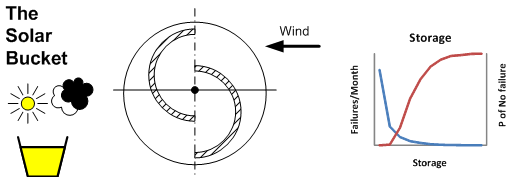
My first attempt around 2007 was the "Solar Bucket", this consisted of three components, a small solar panel, a lead acid battery and several devices to use the energy harvest, the most useful being an early LED light.  The photo shows the panel on a winter's day.


This provided some valuable experience.  It illustrated seasonality, the effects of clouds and much more.  The battery component was originally intended as a measurement device.  I was a little slow to realise it but the battery was the important component, storage is a key element of a sustainable energy economy.  I've heard several people say things like "I want solar panels to make me independent of the energy companies" (or variations n the theme), but the Sun does not shine at night, so without storage they are as dependent on fossil/nuclear fuel as the rest of us.  I argue that investment in energy storage would give a better outcome than more rooftop PV.  As I write this I am staring at more plywood, batteries and wires designed to act as a realistic load for energy management software.

Instructive as the "Solar Bucket" was, it did not act as a resource meter.  This resulted in several attempts at making radiometers.  Initially, these used light dependent resistors and did not work, as these are successfully used in cameras and other devices, the problem was my lack of knowledge.  At some point I purchased a batch of small, flat monocrystalline PV cells for about £1 each and these work well.  The current device could be described as a shaded radiometer and for some reason it attracts the attention of dogs.  The concept is simple, a horizontally mounted cell measures global irradiance, then a shade is placed between the sun and the cell, it then measures diffuse irradiance.  Combine these two measurements with Sun-Earth geometry and you can get an estimate of the direct beam irradiance.

I'm trying to estimate the accuracy of this device, but it suggests that the water content of the atmosphere has has a significant effect on irradiance and particularly diffuse irradiance.  There are some good models of clear sky irradiance, but some of these require data which is not readily available or are related to the climate in which the observations were made, this is an attempt to understand my own back yard.

The first radiometer was simply a PV cell shorted with a resistor, the current and therefore the irradiance was measured by measuring the voltage across the resistor with a multimeter.  For several months, I took readings with the cell horizontal with it angled at approximately 50 degrees to the horizontal.  Under a clear sky, pointing the cell in the direction of the Sun increases the output, this maximises the yield of solar devices in summer, but in winter, the English sky is often full of thick stratus cloud, on these days, the output of the PV cell was greatest in the horizontal position.  The object below was constructed to explore this further.


It consists of a light dependent resistor mounted at one end of a length of waste pipe which is mounted so that measurements can be made around the sky's hemisphere.  On an overcast day, the diffuse irradiance was equally distributed about the the sky, whilst on a clear one it was principally from the direction of the Sun.  This suggests that the yield from PV devices in an English winter might be maximised by mounting the panel horizontally.

My home is located on the western side a a valley in an area where the prevailing wind is from the south west, so we are fortunately sheltered from much bad weather.  Whilst solar is a back yard technology, observing the wind means leaving the house.  A lot of wind speed data is collected in clear open space such as airports, offshore buoys and weather balloons.  The data from these sources often relates to the flow of air over a relatively smooth surface and can have little or no relationship with the wind in nearby urban or rural environments.  In these places, the wind eddies around buildings and trees and neither the speed or direction is constant.  In this type of environment, vertical axis wind turbines offer some advantage.  I horizontal axis machine in an urban setting will often "hunt" for the wind, by the time it has aligned itself with the flow, the gust has dissipated.  I was first introduced to the Savonius design by a university friend from the Caribbean, whilst we were taught about marine, automotive and aircraft engines, simple devices for working irrigation pumps got little or no attention.  The Savonius device has two attractive features, the first is that it is not subject to the complex forces seen in other vertical designs, the second is the ease of construction.  In the West Indies they are often made by cutting a 40 gallon oil drum into two, then welding it back together so that it looks something like the model in the photo below.

A few happy days were spent cycling around the city and taking this model to the top of multi-storey car parks, to the end of breakwaters  and occasionally attracting the attention of dogs.  If you are a man wanting to attract women, borrow a puppy, if you want perfect solitude get a model wind turbine.

I did spend some time messing with a dynamometer for the Savonius model, but abandoned it when I realised that I would have little use for the data.  The Meccano tower lingered in my work room reminding me of the value of time.

What have I learnt?  The main lesson is that a sustainable energy economy is complex, its not just a case of shutting down nuclear power stations and seeding the countryside with wind turbines and putting a solar panel on every roof.  Its a blend of realistic expectations, generation, management and storage which is a large technical challenge, but so was developing the technology for nuclear power stations so we've been here before.  Also don't ignore economics, there is a belief held by some well meaning people that sustainability is above economics, one man's feed-in-tariff is another man's economic cost and this does not lead to good decision making.

Its quite possible to do a lot of experiments with limited resources.  The basic rule is to make mistakes cheaply and realise when you are wasting your time.  I put a lot of effort into a solar thermal device, this had a collector area or half a square metre, looked quite impressive but was useless for anything other than drying washing.  A series of small panels each 10 cm square cost very little and were quite instructive.


Friday, 6 December 2013

Wind is Moving Gas

A recent review of an electric car could be summarized as "This vehicle is not petrol driven".  Like a lot of things energy related, electric vehicles are not a simple swap from an old technology to a new one.  I have never owned or driven an electric vehicle so this is a framework which I might use to evaluate one, a sort of automotive lit-crit.


Most reviews of electric vehicles focus on range anxiety, at a guess this is more do with opportunities to re-charge than the distance/charge, typical numbers seem to be in the 100 - 200 km range.  I live in an area of controlled parking which is next to a railway station.  A statistically invalid survey of the parking permits of the vehicles in our road, suggests that 40% have travelled less than 1 km and that the remaining 60% have travelled less than 5 km and are parked in a garage or driveway at night.  The record shortest journey is 150 metres.  Whilst many of these vehicles are capable of crossing continents, most don't.  Whilst I have not lived in the US, I have spent a lot of time working there driving the American Dream (a.k.a. a Dodge Neon), even with a full schedule it was rare to travel more than 150 km in a day.  so with the significant exception of family holidays and trips to granny, range for many people is not an issue.

Cost is harder to deal with.  Half an hour of Googling and doing things with a pencil resulted in the following conclusions, first that electric cars are expensive to buy and secondly if charged up on-off peak electricity, cheaper to run.  What that does for my wife's 40 km commute is not obvious.

A neighbour recently described me as an "eco" because I rarely drive and prefer my bike, but I'm male and therefore lust after low slung sports cars (although my car-boot bike maybe quicker around town, sadly, beyond the city limits its not a contest).  I might drool over a Tesla.

I dispute the claims that electric vehicles produce zero emissions.  In the UK electricity is produced from a variety of sources including coal, gas, nuclear, wind and solar, last time I looked, CO2 emissions were around 0.4 to 0.5 kg/kwh for the country as a whole.  The environmental issues are at the point of generation not the car.  The fuel for electric vehicles is coal, gas, nuclear, wind and solar rather than petrol.

In the context of a sustainable energy economy, electric vehicles offer personal transportation using renewable sources such as wind and solar.  Equally important is that they are mobile storage devices.  A typical car spends 5% of its time on the road and 95% waiting to go somewhere.  Wind and solar sources produce energy at the whim of the weather and fossil/nuclear sources are most efficient at a constant load, this is why off-peak electricity maybe half the standard price.  The storage capacity of electric vehicles could be used to improve energy management as a peripatetic part of a smart grid.

At present, the case for electric vehicles is not proven, a situation made more complex by the availability of subsidies.  Subsidies are a good economic tool to bring about change, but they can also be proof of the doctrine of unforeseen consequences.

A not to close look at the electric vehicles on offer suggests that they "not petrol driven".  As electric vehicles are a new technology, maybe the starting point should be elsewhere.  A few times when I have been meandering through the countryside I have been overtaken by a golf buggy.  These vehicles cost around £4,000 (I think) and have been adapted for use on the Moon, so making them fit for the daily commute should not be too great a challenge.  A vehicle costing £5,000 with low running costs and a range of 200 km would be the car most people need, but maybe, not the car they want.  However, make a low slung version with good curves and you have a Sinclair C5 - Who said they were a bad idea?

Safety on the roads is an issue and the ability to survive a collision is important, once you have been in accident, this is not an academic concern.  Much as I love my bike, I am acutely aware of it's vulnerability and I nag my children to wear cycle helmets.  The city I live in is flirting with 20 mph speed limits, does a 20 mph environment offer the potential for lighter vehicles?

Postscript

After I finished this post, I saw an innovative electric trike, driven by a combination pedals and an electric motor fuelled by four lead acid batteries and a Mars bar.  I gave chase, but quickly lost contact before I could ask the owner's permission to take a photo.


Friday, 22 November 2013

A Brief History of Walls

Much of the housing in the area in which I live was built in the period 1870 to 1910.  Over the years gaps have appeared and the suburb has expanded to displace sheep from the surrounding farm land.  New houses have appeared on the lawns of grand houses, small orchards, market gardens and in a couple of places the side of a hill.  Whilst the style of building has changed, it is only in recent years that the method of construction has evolved.

The driving forces behind this evolution has been the Building Regulations and a change in the nature of home economics.  Prior to 2000, the general philosophy was to focus on capital costs, fuel for heating which is a major components of a home's operating costs was relatively cheap and a common way of getting a warm home after the arrival of North Sea Gas was to install lots of radiators.  This was not significantly different from the attitude of the Victorians who believed in the health benefits of ventilation and and whose homes needed a good supply of air to keep open fires burning, for them coal was relatively cheap.

Modern houses are built on a completely different principal, they have a higher capital cost but are intended to have much lower operating costs, not only that they are warmer.  The sketch below shows the difference between an old wall and a modern one.  For well over a century, the most houses were built with cavity walls which are just two single brick walls separated by an air gap and the inner wall finished with plaster.

Modern walls are significantly different, the outer layer of bricks might be similar, but the inner wall consists of a layer of foam insulation in front of blocks with good thermal properties and the finishing is insulated plasterboard.  In very rough numerical terms, old walls may have had U value greater than 2.0 watts per metre squared per degree C. whilst that of a modern wall will be less than 0.5.  In non-numerical terms you don't need much heating.  A proud owner of such a building I met recently did describe an alternative to a gas central heating boiler as a form of heating, but that may have been wishful thinking.  The sketches are not from the studying of Building Regulations, but the result of staring into building sites whilst walking my dog.

It is not only the construction of walls which has changed, but doors, windows, roofs.  Double glazing in sealed frames is now the standard and the thermal properties of these are significantly better than a single glazed sash window.

As someone interested in the concept of a "sustainable energy economy", I am sometimes puzzled by focus on energy generation.  I occasionally do a non-scientific survey of the contents of "science and environmental" sections of the media.  The stories range from the bizarre such as "Wind Turbine catches fire in Gale", "Planning permission application for new solar park", "Minister declares offshore wind farm open" and similar.  Only rarely is there an article on conservation or storage.  Its not hard to see why, few journalists or politicians can make much of a house brick, LED light or boiler controls.  Apart from a famous photo of Winston Churchill building a wall, I can't remember any interesting picture of an MP gazing lovingly at a brick.

Postscript

Shortly after I posted this, I heard a news report stating that during the prolonged winter of 2012/13 there had been 30,000 excess deaths (meaning more than normal) and that many of  these were due to old people living in cold homes.  In part, this is due to the way homes were constructed when energy was relatively cheap and plentiful.  Now that this is no longer the case, many homes, especially those of pensioners on low incomes are underheated.  Whilst I don't want to dismiss the value of retro-fitted insulation, in many cases a modest expenditure only makes the house less cold, not warm and does not cut energy bills.  Over a very long period, many thermal disasters will fall down or be demolished, but that will not do much for the generation currently living in them.  It would help if policy makers understood the problem and not ranted on about the imperfect working of the domestic energy market.


Friday, 6 September 2013

Pumped Water Storage

Pumped water systems store energy by increasing the potential energy of a mass of  water by pumping it from a lower reservoir to a higher one, then recovering that energy with a turbine when it flows back down again. The diagram below shows the  main components of a system which acts as a form of battery. During the "charge"  phase electric motors drive pumps which move water from the lower reservoir to the upper one. The energy is recovered when the water flows back to the lower reservoir and passes through turbines which drive "generators".  There are losses associated with the process, the figures quoted in Wikipedia suggest that typical efficiencies are in the range 65 - 85%.
The basic equation which describes the systems storage capacity is shown below.  The simplicity of the equation is in contrast to the construction of these of system which are often massive civil engineering projects.
The key term is the product of V and H.  For utility scale projects, the volume V is typically of the order of millions of cubic metres whilst the height, is tens or hundreds of metres.  The density of water rho is constant of at 1,000 kg/m3.  The acceleration due to gravity is also a constant at 9.81 m/s2 and the efficiency eta is a fraction less than one.  The efficiency of the Dinorwig plant in North Wales is thought to be around 75%. Q is the energy stored in Joules (1 kwh represents 3.6 MJ).

A typical urban water tower with a height of 30 metres and a storage volume of 1,000 m3 if used as a  pumped water storage system would have a capacity of approximately 50 kwh, assuming an efficiency of 60%.  However, major installations such as Dinorwig have sufficient capacity to provide some grid management capability by using electricity during off-peak periods to fill the upper reservoir and provide 1 to 3 GW of generating capacity during peak demand.

Pumped water is the principal grid scale storage technology.  The energy storage density is low, in the water tower example used above, the density is 20 tonnes/kwh. For small scale systems, the cost could exceed £1,000/kwh, these figures are high compared to lead/acid  batteries which might cost around £250/kwh for a similar sized system.  The main strength of pumped water is that very large quantities of energy that can be stored, much more than is possible with the various battery technologies.  Pumped storage systems are major civil engineering projects, some are based on disused quarries, others on large dams and disused mine workings are being considered for conversion. Existing systems have generating capacities similar to those of small to medium sized power stations, the buffer capacity for most grid systems is measured in hours rather
than days.

Links to other sources


Sunday, 1 September 2013

Laundry

One of the side effects of installing rooftop PV is a desire to balance generation and consumption. I know of one father who is frustrated by his daughter's use of hair straighteners.  A recent piece in "The Guardian" told of a couple who were surprised by the amount of energy used by a tumble dryer.  Proof of the doctrine of unexpected consequences is that working from home results in swapping the daily commute for domestic chores.  In an attempt to turn laundry into environmental science, I sometimes weigh the washing before hanging it out to dry and then once again when it is it back in the house.  The results of a year's bizarre behaviour are shown in the graph below:


Over the year, the average water removal is 1.5 kg/wash.  By making some assumptions about the efficiency of tumble driers, this approximates to the equivalent of 600 kwh/year, which might account for say 10 - 20% of the average household electricity consumption of 3,500 kwh/year.

Several houses in our road put their underwear on public display a couple of times each week. but there was a time when most households had a washing line and a prop to keep sheets of the ground.  To authenticate this statement, consult the works Shirley Hughes, a favourite author of bedtime stories for many children.

In the newspaper supplements which attempt to promote "eco" living, you will find adverts for rooftop solar water heaters (useful for six to eight months each year) costing around £3,000, ground source heat pumps for even larger amounts, but with the lure of RHI payments.  Washing lines and whirligigs seldom figure in these publications.  We are fortunate in having a conveniently placed railing, but if we installed a proper south facing washing line, the cost might be £100 for poles and concrete foundations, this would be an investment which would pay back in a couple of years.  Laundry is not a sexy subject, even for environmental journalists, so can the lifestyle gurus make laundry fashionable, reduce emissions and boost energy security?

Conservation is difficult for politicians, our present government has attempted to be "the greenest government ever", but it is easier to encourage wind turbines than washing lines.  Does 10 Downing Street have a whirligig?


Friday, 16 August 2013

Urban Wind

Munn's third law states that any place you can wear a kilt or a skirt without embarrassment might not be a great place to put a wind turbine.  With this in mind, I spent a few mornings cycling round a seaside town with a simple wind speed meter in an attempt to get an understanding of urban wind.

Until recently the most common source of wind speed data was weather reports from airfields. These are large open spaces and the weather station is usually located somewhere close to the point of touchdown where its data will make the greatest contribution to aircraft safety.  This is in contrast to most residential and commercial areas which are cluttered with buildings, trees and infrastructure such a bridges all of which might be crammed into hillsides and valleys. In the past few years, data from small weather stations mounted in backyards has become available.  The two sources give different impressions, typically, airfields have a average annual wind speed in roughly in the range 4 - 7 m/s, whilst backyards might experience 1 - 4 m/s.  As with all gross generalisations, there are exceptions, but my own backyard sitting on the sheltered side probably has an average of around 1 m/s based on many calm days and a few gusty ones.

Wind speed measurements are typically taken at a standard height of 10m although there are some important exceptions, for offshore buoys it is often 4 - 5 m, for offshore platforms it can be well over 100m (to assist helicopter operations).  Private weather stations can be at any height available to the owner. However, they are generally located at the base of the boundary layer which is not an ideal place to put a wind turbine.  Utility scale machines are mounted on towers, typically 100 metre tall which lift the rotor out of the turbulent and complex air flows found around roof and tree tops.  The photo shows a medium sized wind turbine mounted on a tall tower in an urban location:


However, this type of structure is not practical/acceptable in the average backyard, so wind found at approximately 10 metres is the the resource that is available to most people (subject to neighbours, town planning and building regulations which keep towns and cities safe and relations between residents harmonious).

The plan was to cycle around the town taking wind speed measurements at a variety of locations and compare them to data from a small airfield a few km to the west.  In a failed attempt to introduce an element of street theatre I took a small model of a Savonius wind turbine with me.


Whatever other merits it may possess, the Savonius design can withstand the rough handling that comes from being strapped to the back of a bike.

During seven outings I found about 20 locations where I could take measurements.  With the single exception of a curious dog, this bizarre activity attracted no attention.  The locations included the seafront and a breakwater, the roofs of multi-story car parks and my own backyard.  One days results are shown in graphic form below:

Moderate winds at the airfield are usually smooth and there is a good relationship between the wind there and that experienced on the sea front.  In these places the Savonius model would spin continuously when the wind was greater than 3 m/s.  However, in the town, suburbs and parks the wind was usually attenuated and turbulent, the graphic is a sketch of the relationship between "clear" and "urban" wind:

The rooves of car parks were the most interesting, all five locations were well above surrounding roof tops, yet in all cases, the wind was turbulent and it was rare for the Savonius model to spin continuously.  Having seen several horizontal axis wind turbines in urban locations they often appear to "hunt" for the wind then spin up and down with the gusts.  The vertical axis Savonius was usually quick to respond to gusts, however, the coefficient of performance is low.  The coefficient of performance is the fraction of the wind's energy that the turbine manages to extract.

The relationship between wind speed and power is cubic, thus a 5 m/s wind has almost five times the energy of one of 3 m/s, the relationship is complicated by variations in a turbine's coefficient to performance with wind speed.  In general, the coefficient of performance declines with increasing turbulence.

It is probable that a suburban area with low and widely spaced housing on flat land might give more encouraging results, but in a densely populated English town, small wind turbines have limited potential for generating significant amounts of energy.  The greatest potential for wind energy appears to be large turbines located offshore where average annual wind speeds are significantly higher than those onshore.  However, offshore wind is still a weather/climate dependent energy source.


Friday, 9 August 2013

Negawatts vs, Megawatts

There are two ways to reduce emissions and increase energy  security.  The first is to use less energy and the second is to generate it from renewable sources.  The two approaches are not mutually exclusive and both are desirable but they compete for resources.  Around 2006, I became interested in renewable energy, up to that point, I had not thought too much about consumption and at that time electricity was reasonably priced.  Typical grid-tied, rooftop PV installations produce between 1,500 and 2,500 kwh/year.  A good starting point was to try reduce our consumption to the level at which a form of self-sufficiency could be attained.

Alongside my interest in renewable energy, is a belief that investments which are good for the environment, should also be good for me.  Added to this is the belief that sound investments are based on fundamentals (e.g. fuel savings) and should not be driven by tax regimes or subsidies, In other words, I'm prepared to buy an item which reduces my emissions, but I want to be rewarded in the form of lower energy bills.  For energy consumption, and therefore emissions to fall, there should be a "virtuous circle" by which I use less energy and I am better off as a result.  This should be possible to achieve, energy is now expensive.

Whilst I am fascinated by solar devices and wind turbines, conservation was consistent with my opinions (my favourite coffee mug has the slogan - "everyone's entitled to my opinions").  The graph below shows our household's estimated electricity consumption since 2005:


When we started there were some quick wins, incandescent lamps were replaced by CFLs and old computers which were better room heaters than number crunchers were replaced by laptops.  The gas driven domestic hot water system was an economic mess consisting of a gravity feed system with an efficiency of 20% (a charitable estimate).  This took an average to two hours to create a warm bath, therefore anyone needing to be clean used the immersion heater (cheap at night, but expensive during the day).  The water heating was upgraded to a pumped system which also reduced the gas bill and did not leak.  Rough estimates of the breakdown of consumption "before" and "after" are shown below.


Since 2007, consumption has drifted down to an average of 6 kwh/day, mainly as a result of taking account of energy efficiency as things like fridge have had to be replaced and just being aware of our energy consumption.  We are not wandering around in Stygian darkness obsessed by energy bill dropping through the letterbox.

The law of diminishing returns is beginning to assert itself, we are starting to replace CFL lamps with LED ones which may take us down to 4 kwh/day over the next one or two years.  Our electricity consumption will probably be in the range 1,000 to 1,500 kwh/year, which compares well with the national average of around 3,500 kwh/year (comparing averages is always dangerous).

It has to be said that a wind turbine in the back yard would be fun but as I have embarrassed myself on countless occasions by wandering around the garden with a wind speed meter consistently reading 0 m/s and have no desire to annoy my neighbors, this is not going to happen.  The sun does not shine at night and rarely during winter, so rooftop PV does not appeal.  So, I will press on with the LED lights.

Sadly, conservation is not sexy.  Acquaintances with rooftop PV who have seen me cycling around with a model wind turbine strapped to my back ask me why my south facing roof is empty and an unscientific survey of the environmental pages of the papers (read on my phone) suggests that greater coverage is given to wind farms than to things lurking in cupboards like boilers, heating controls and meters.  A knowledge of the capabilities of smartphones is a sign of virility whilst being able to read gas and electricity meters is considered boring.  Typically, a mobile phone bill is in the range £15 - £30/month, whilst energy bills often exceed £100/month, so there is an incentive to take an interest.

The scale of investment is also an issue, I have the occasional outing to an "eco" fair where a high proportion of the offerings are green boxes with a price tags well over £1,000.  This is not the sort of money that fits well into a typical family budget, yet £10 for an LED light or a few quid extra for a more efficient fridge or washing machine can make a difference over time.

Policies which focus on conservation are difficult for politicians, offering subsidies for generation projects gives an incentive to do something.  Telling people not to do something, i.e. use energy is creates a range of reactions ranging from indifference to to charges of infringing of civil liberties:.


Its better to make a good case for energy efficient lighting than embarking on legislation which does not win hearts and minds.  Had we not adopted CFL's are electricity bill would now be approaching £100/month.

The link between environmental benefits and high cost objects also seems to be well established in (some) political thought processes.  During the 2010 election I was accosted by a canvasser keen to establish the environmental credentials of their chosen candidate, in the interests of fairness, it is probable that I was being a pain at the time, but the patter went along the lines "Of course she can't afford a Hybrid Car". My understanding of hybrid vehicles is that by combining a petrol/diesel engine, motor/generator and a battery you can make a fairly efficient vehicle for £27,000, however, some conventional vehicles, often described as "dull" by reviewers, offer similar performance for much less.  Other options include a small car, no car and a bicycle.  If you live in a remote rural area, you need a car, if you live in a city, a bicycle makes sense economically and environmentally, that also seems to be the view of the current Mayor of London, the man behind the Boris Bike.

Next week - Urban Wind