Pages

Saturday, 16 April 2016

A consumer's relationship with coal and gas

I recently read "the world did not run out of coal, it just stopped using it", with the implication that a similar process might take place with other fuels such as oil and gas.  A back-burner project has been to collect household energy costs from old utility bills and related sources (an unexpectedly fruitful source has been Hansard - the record of proceedings in the UK parliament).  This type of material shows how energy costs are perceived by the consumer.  Householders are generally rational in their decisions, seeking to minimize both cost and effort.

It is difficult to make prices comparable over time.  The purchasing power of money changes over time and there are different things to buy, so estimates of price change over a long period of time are an approximation.

This post is based on comparisons, but the data should be treated with caution because of the difficulty of making like-for-like samples.  In the days when coal was purchased by almost every household there were significant variations in price due to the quality of the fuel with nutty slack at the cheap end and anthracite at the other, the sources do not always quote the type.  Distance from the goods yard could be significant.  People on low incomes might purchase a stone (14 lb, roughly 6 kg) for cooking at a much higher unit cost than a household taking half a ton in a single delivery.


The price of coal in 2015 money remained more-or-less constant within broad limits for the period  1900 to 1970.

Gas is slightly simpler, but there were and are regional variations and in the post war period there was a transition from "town gas" made from coal and "natural gas" from the southern North Sea gas fields.  The nature of the gas industry is such that it is easier regulate, whilst there were a large number of coal merchants, there were relatively few gas companies, many of which where owned by town councils.  Most companies served a single area and there was limited competition.  Within the home, electricity displaced gas as the energy source for lighting by the 1930s.  The main uses for as were for cooking and until the advent of central heating in the post ware period, gas fires were a common way of heating a room. 

The availability of gas from the North Sea started a 40 year period of low energy prices which lasted form approximately 1965 to 2005.

A cursory reading of Hansard suggested three things.  First that energy prices are a constant source of public, and therefore parliamentary concern and that this is accentuated in difficult economic times.  Secondly, that there is a general distrust of energy suppliers, coal merchants in the 1920s were attracting much the same criticisms as today's gas and electricity suppliers.  What politicians of all persuasions seem to want is a regulated energy market which is isolated from global economic turbulence.  Sustainable technologies go some way to meeting this requirement.

The householder does not purchase a hundredweight of coal or a therm of gas, he/she buys warmth and the facility to cook.  Open fires accounted a for a large proportion of the coal burnt in England, whilst a coal fire is cheerful and comforting, it's thermal efficiency is low, possibly less than 20%, stoves equipped with a back boiler were more efficient, but a large amount of heat still went up the chimney.  Modern stove designs seem to be a big improvement on those of the 1950s and 60s.  As a gross oversimplification, someone wanting 1 kwh of warmth might have to purchase enough coal to produce 4 kwh if the fireplace was 25% efficient.  Gas central heating boilers might offer 90% efficiency.  Making assumptions about thermal efficiency produces this graph which shows the effective energy cost of  coal and gas assuming thermal efficiencies of 25% and 90% respectively.


The crossover point is sometime in the 1960s, this is when our parent's generation blocked up the fireplaces and installed gas central heating.  Gas was not only cheaper than coal, it was cleaner and easier to live with.  Another benefit of gas was improved air quality, well into the 1970s thick fogs were a frequent occurrence due to the high proportion of soot particles in the air.  This in turn provided a decrease in respiratory disease.

The sustainable energy technologies sit uncomfortably with economics, the transition from coal to gas was largely driven by the cost advantages, my source for this comment is my parents and their friends.  If a similar transition is to take place from gas to sustainable sources, the energy consumers, who are now our children, must perceive some economic benefits.


Saturday, 9 April 2016

Laundry and Energy - A Personal History

Laundry is one of the more energetic domestic chores, either for the person doing the washing of the machine to which it is delegated.    During the past few weeks the renovation of the kitchen has been a large part of my life (I desperately need to get out more).  What we now use as the kitchen used to be the scullery.  A scullery is might be described as the Victorian's idea of a utility room, there was a large coal store, storage place for food marked on the plans as "larder" and usually referred to a the pantry", a sink for washing dishes and a "copper" for washing clothes.  The copper can be seen on the plans:


The copper, possibly made of cast iron, was mounted in a brick structure, the lower section of which was a small furnace.  I've looked several house plans and as far as I can see, these things were not connected to chimneys, so the weekly wash would have been done amid smoke and carbon monoxide.  In 1900 much of the laundry work was boiling clothes and bed linen.  Boiling 5 gallons of water might require 2 kwh, but allowing for the heating a mass of brickwork and other losses, the total energy consumed might be 10 - 20 kwh or in more practical terms, a shovel full of coal.  Add to this the physical effort the laundry itself.

I'm guessing, but coppers remained in use in our family into the 1920 or 1930s.  My mother carried on boiling things into the 1960s.  This might have been a fear of disease, in her youth, there were a lot of things that could become fatal like TB, scarlet fever and measles.  Boiling would have dealt a deathblow to those microscopic lifeforms known as germs.   My early memories of Monday, the day of laundry, are centred on the "Baby Burco" which was the 1950s equivalent of the old copper, which by then was gas fired.  Clothes were extracted from this cauldron of soap and boiling water with wooden tongs.  After use, the hot water was dumped into the drain one bucket at a time, this may have been good for the drain, less so for those doing the work.  The energy uses might have been 2 - 4 kwh.

It was many years after leaving home before I encountered another Baby Burco.  This was at the back of the local greengrocer (now a Thai takeaway) where the owner used one to boil beetroot.  After the success of the Harry Potter novels, it would require only a small stretch of the imagination for a young adult to see a wizard stirring a vat of blood red potion before dispersing it to the neighbourhood through the sewers.

The Baby Burco was finally replaced by a washing machines which might be described as an electrically heated tub with an agitator, the buckets were replaced by hoses and wires, the danger of scalding decreased, but the risk of flooding increased.  I'm guessing but the energy used also decreased, but the stress levels remained high.

For quite a long time, I found better things to do with my life than measure the energy consumption of washing machines, but in 2010 I bought an energy meter.  When applied to the then current washing machine, it seemed that the device consumed roughly 1.0 - 1.5 kwh/wash including the hot water it took from the hot water cylinder.  I never, investigated the inner working of this thing but I think it heated the water from the "hot" supply if it was below a certain temperature using electricity as it's electricity consumption dropped once we fixed the hot water system.

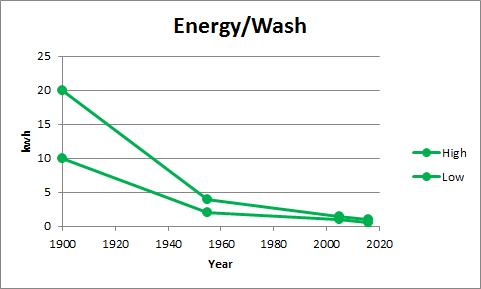
A few days ago the old washing machine collapsed under it's own weight into a heap of foul smelling rust and water, depriving a newt of a home in the process.  The new washing takes advantage of a microprocessor and advances in detergent technology and seems to consume 0.5 kwh/wash.  The trend in energy consumption is shown in the graph below.


This graph is potentially misleading as it does not take account the size of the wash.  In 1900 there would probably been one big wash on Monday, whilst a modern family might run the washing machine several times per week.  A better graph would have needed more research.
PS - To replicate Brownian motion, place an unlevelled washing machine on quarry tiles.

Monday, 4 April 2016

Off-grid in 1911

This is a letter to the editor of "The Model Engineer and Electrician" which appeared on 29-Jun-1911.  It is in two parts, the first gives a description of the use of engines in farming and the second is a discussion of the use of lead-acid accumulators to provide domestic lighting.  I've edited the text slightly and illustrated it with adverts taken from the same magazine.

The prices in the adverts are in "old money" i.e. pound, shillings and pence.  One pound in 1911 is very roughly the equivalent of £95 today.  The output of bulbs described in the adverts is given in candle power, this is not directly comparable with the lumen used today, but a very rough comparison might be that 1 candle power is equivalent to 10 lumens (this is a guess).

The business of up-to-date farming needs, in addition to much other knowledge, a good general knowledge of engineering and mechanics. Labour saving machinery is continually being introduced on the farm, and the success or failure of this machinery is largely dependent on the way it is looked after. To illustrate the usefulness of model engineering, I may say, as a practical farmer, that the number of times that serious loss of time has occurred through the breakdown of machinery would have been a very small one had I practised model engineering as a hobby in my younger days.  Such simple things may hinder a gang of men at harvest time, such as the thread worn from a pin, the breaking of a spring; and this when delay may mean the loss of a crop.


The cost of this generator set in today's money is roughly £1,250.  The text states that it will run of either petrol or gas
Years ago farmers used to do all their chaff-cutting, root-pulping, etc., by hand and used to send their corn to the local mill to be ground. Now, all up-to-date farmers have an oil engine, motor engine or steam engine to do the work and the latest idea is to have an engine which will do all the pulping, grinding, etc., threshing, and haul the implements on the land. Trials were held last year by the R. A.S.E. to test such motors, and to the surprise of many, a steam engine won. The ordinary oil engine is generally used on farms; but the petrol motor engine being largely offered the market.  In my own case, I use a motor engine, one that starts on petrol and works on paraffin, and I think this is the type that will be the greater favourite, because duty-free petrol at 11d (approx. £1.00/litre). is much dearer than paraffin at 4d (approx. £0.35/litre).   I am afraid, however, that as long as motor engines are electrically ignited, they will never be so popular with the farmer as the ordinary oil engines, which have not accumulators to run down, plugs to soot up, contact-makers to get worn, and the other little troubles with which the busy farmer would perhaps soon get out of patience.


Personally, however, I would not exchange my little motor engine of  3 to 4 bhp for the best ordinary oil engine. It is so easily started, and can be used if only a bushel of corn or a bag of chaff is wanted. It is on wheels, we keep it in the barn in the winter and in a sort of workshop close to the house in the summer time, where we saw wood for fires, also for making any rough articles which may be required. Whilst the engine is doing this work, from a second pulley a small dynamo is driven
which charges several 4-volt accumulators which are used for lighting parts of the house and buildings.


These lights are very handy indeed, in fact, I have been so impressed with this 4-volt lighting that I am thinking of putting it all over the house. In the stables it is particularly useful.  as we find a small 2 or 4 c.-p. lamp is ample for a 3-stall stable; in fact, it gives a much better light than a lantern with a smoked globe.  About the house, too, In the pantry, cellar, dairy, bathroom, back-kitchen, etc., a 2 or 4 c.-p. gives ample light for the purpose for which it is required. In small bedrooms, too, it is ample for a man; but, needless to say, a lady would require an additional light at the looking-glass.


What I like about 4-volt lighting is that I can do the wiring myself, and feel pretty safe a fire won't be caused, though I am aware a short circuit close to an accumulator would possibly cause a fire if no fuse was in circuit.  Another thing is that it is easy to get 4-volt portable accumulators.   Then, if I went in for 25-volt lighting, It would all have to be done from one stationary battery, and it would be a big business laying the wires under roadways, etc. and cost a good deal. As It I have one accumulator for bedrooms, etc. another for pantry, etc. another for stables, and another for cow houses etc. It hinders, rather, connecting up for charging and redistributing the accumulators again; but It is very little trouble when done regularly.


Saturday, 2 April 2016

A Lockheed Vega in the bedroom

The space under our floorboards is a small time capsule.  There are at least four generations of electric wiring, old gas piping and the evolutionary history of plumbing lead to plastic.  All this and litter left by electricians, plumbers and carpenters over the better part of a century.  I'm currently my own builder working my way round the house after a long period of neglect, initially my intention was to leave as much stuff undisturbed as possible but it has been necessary to clear some junk to get straight pipe and cable runs.  It's a nice change from software development but it can be a little dull and dirty, however, the litter has made some of the work seem like historical research.  The first generation of electrical wiring was made by W.T. Henley who at one time made submarine cables.  Some of the older copper piping is a reminder of Yorkshire Imperial Metals.   Fag packets and bits of clay pipe have been found in several places.

Maybe, until the 1960s smoking was what a lot of people did and many of those who had lived through the war had taken up smoking to calm their nerves.  In my youth, I worked in a factory and the tea breaks were sometimes referred to as a "smoko".

Whilst poking around under a bedroom floor, I came across an empty packet of "Weights".  My mother smoked "Weights", I think because they were a step-up from Woodbines (a.k.a. Woodies) and did not give you yellow fingers like "Senior Service".  The fags were gone, but the card remained, I guess it was discarded sometime between 1935 and 1938.

It is No. 36 in John Player's Civil Aviation Series and describes a Lockheed Vega.  These cards were advertising and designed to encourage brand loyalty but the picture and the text on the reverse are not too far removed from what you might find in "The Observer's Book of Aircraft". 


I know little about cigarette cards other than what I have seen a car-boot sales, but it seems that if you just looked at the cards and read the paragraph on the back, you would be slightly better educated and have a knowledge of things that  are beyond normal experience.  I can't think of a current from or commercial interaction which has that effect.

The text on the reverse is:

This surface is adhesive.  Ask your tobacconist for the attractive album (price one penny) specially prepared for the complete series.

Aeroplanes (Civil)

A series of 50 selected by the editor of "The Aeroplane"

No. 36 - Lockheed Vega (USA)

The "Vega" is a successful high speed type of small commercial monoplane built in the United States
in considerable numbers.  It carries a pilot, situated in a cockpit just below the leading edge of the wing and six passengers in a small Cabin behind.  The late Cmdr. Glen Kidston 'used a" Vega" on his record-breaking flight to the Cape and the machine illustrated was flown round the world in 187 fly-
hours by Wiley Post in 1933.  Miss Amelia Earhart  also used a "Vega" on the first solo flight across the Pacific in January 1935.

John Player & Sons

Branch of the Imperial Tobacco Company of Great Britain and Ireland Ltd.

Friday, 1 April 2016

Lighting in the 19th, 20th and 21st centuries

This post is in two parts, the first is Chapter XV of the 1894 edition of "The Handbook of Household Management and Cookery" by W.B. Tegetmeier which gives a description of the options for lighting the home in late 19th century England.  The second has been compiled from family experiences in the 20th and 21st centuries.

Chapter XV - Lighting: Candles, Petroleum, Benzoline, and Gas Lamps, Their Management, etc.

99. Flame, which gives the light employed in our houses during the absence of the light of the sun, is always produced by the burning or combustion of inflammable gas.

When a candle is lit, the fat, wax, or other material of which it is formed, is melted, then drawn upwards into the flame by the attraction of the wick, it is there heated so strongly that it is converted into gas, which burns as fast as it is made, thus producing the flame.  In oil lamps the same happens, and in gas burners the gas burns as it escapes.

100. The gas which is burnt to give us artificial light, whether obtained from coals and supplied through pipes, or produced in the burning of a lamp or candle, consists chiefly of two substances, namely, hydrogen, which is always a gas, and carbon, which when not united with hydrogen or any other substance is usually a black solid, like charcoal or soot.

101. Both these substances burn in the flame, uniting with the oxygen of the air. The hydrogen in burning forms water, a large quantity of which passes off from every flame in the form of vapour or steam. Many gas lights in a close room make the air very damp, and the moisture they produce may often be seen settling on the cold glass of the windows, or even running down the walls. The carbon or charcoal when burnt forms carbonic acid, an invisible gas. When there are many gas lights in a badly ventilated room, or even one in a room that is not ventilated at all, the air becomes very unwholesome from the presence of carbonic acid gas.

102. If there is not enough air to enable both the carbon and the hydrogen to burn, the hydrogen burns first, and part of the carbon passes off in the form of smoke. By putting any cold pieces of metal, glass, or earthenware into a flame, the carbon is prevented from burning and settles on the metal or glass, covering it with black soot.

103. Candles, which were formerly very generally used, give out very little light and are the dearest mode of producing light.

Much may be learned of the nature of flame by watching attentively that of a common candle; at the bottom is a pale blue light which is caused by the fresh air rising against the flame and producing the perfect burning of both the carbon and the hydrogen; in the interior of the flame is a dark centre which consists of the unburnt inflammable gas rising from the wick; this cannot burn until it reaches the air outside. The outside of the flame is very bright it is there only the gas burns.

If a smalls slip of wood be held for a moment steadily across the centre of a flame, it will be seen that the part in the middle is not burnt, only that which was at the outside of the flame.

104. The oil used in lamps is of two distinct kinds. The fat greasy oils, such as seal or whale oil from animals, and olive or colza oil from vegetables.  obtain a good light from these fat oils it is necessary to make the flame hollow, and admit air into the interior, as is done in what is termed an Argand burner.

In order to cause a strong current of air through the flame of an Argand, a tall glass chimney is requisite.

105. The mineral oils, called paraffin or petroleum oils, are the cheapest oils in use They contain a very great amount of carbon or charcoal, and if they are burned without a chimney this escapes into the air in dark clouds of black smoke. These oils, therefore, require to be burned in a properly constructed lamp, so that sufficient air shall be sent against the flame to consume all the carbon.


The best paraffin lamps are those with a single flat wick, which is able to be turned to any required height above the wick tube A, by small toothed wheels turned by a handle, B. The large quantity of air required by the flame rises up through the cone or cap c, and is directed against the sides of the flame, producing a complete combustion of the carbon, and a very brilliant light.

Paraffin or petroleum oils were formerly sold containing much volatile inflammable spirit. At the present time no mineral lamp oil must be sold which is dangerous.

Petroleum lamps are perfectly free from danger if properly used. The oil-holder should be of glass, as if made of metal, it is apt to become heated. The lamps should always be filled before dark, and never after being lighted.

Any oil spilled on the outside should be carefully wiped off, or it will produce a disagreeable smell when the lamp is used. To light a petroleum lamp the glass chimney should be removed, then the wick turned above the slit in the cone, and when lighted instantly turned down again; the chimney should then be put on and the wick turned up so as to produce a large bright flame without smoke, but so as to produce the full If the flame, when the lamp burns without smell. flame is turned down low, there is no saving of oil, as a large quantity is sent off in vapour and produces a most disagreeable smell.

106. Sponge or spirit lamps are made for using the very inflammable spirit termed benzoline. They are filled with sponge or cotton wool which is moistened with benzoline, the wick-holder is then screwed on and the wick turned up level to the top; when lighted a small flame, rather greater than that of a candle, is produced. As the benzoline is very inflammable these lamps should never be trimmed after dark, or near a fire, as the vapour may take light. If trimmed in the day-time, and only enough spirit poured in to moisten the cotton wool, they are quite safe, and are the cheapest source of a small light. When used as night lights they should always be placed under a chimney as the vapour escapes and smells when they are turned down low.

Coal gas is unquestionably the cheapest source of light, but it's economy is not so great as is generally imagined ; the flame cannot always be brought where it is wanted, consequently a much greater amount of light is necessary than when movable lamps are employed.

For small rooms, the two-hole, or fish-tail burner is best, being cheap, simple, and capable of causing a very perfect combustion of the gas. With this burner the flame is spread out into a thin, flat sheet, by the two currents of gas striking against one another. In a fish-tail burner the gas should always be turned on so as to cause a full-sized flame without flickering, as otherwise the gas is not perfectly burnt. A large-sized burner should not be used where a smaller one will answer. The flame gives a much brighter and steadier light when placed horizontally with the flat sides turned up and down, than when burned upright in a glass globe, when the flame always flickers and is injurious to the eyes. An ordinary-sized fish-tail consumes from three to four cubic feet of gas per hour, and gives the light" of from six to nine candles.

Where a great amount of light is required a circular or Argand burner is more economical than the fish-tail.  In most burners the chimney is too high ; this causes too strong a current of air, and a great loss of light ensues. An Argand with a ring having fifteen holes, should not have a chimney more than seven inches high. Such a burner will consume about five cubic feet of gas in an hour, and give an amount of light equal to that of fifteen sperm candles.

In all cases where gas is used, the room should be ventilated, or the air will become very unhealthy from the great amount of carbonic acid and vapour of water produced.

Explosions sometimes occur when gas has escaped from a leaky pipe or a burner that has been left open, The explosion is generally caused by some person taking a lighted candle to discover the leakage, when the escaped gas takes fire instantaneously, and burns with a violent explosion. Whenever there is a strong smell of escaped gas, the main cock at the meter should be immediately turned, and the doors and windows opened to allow the gas to escape. No attempt should be made to search for the leak with a light, but notice should instantly be given to a gas-fitter.

The above describes the experiences of the old ladies of the family who were grateful for light that could be turned on or off with the flick of a switch, as girls, it has been their job clean grates, lamps and deal with soot, ashes, damp and lamp black.  Electric lighting started appearing in public places in the 1880s in the form of arc lamps which with electricity costing the equivalent of £5/kwh were expensive to run.  In the 19th century, electricity was a luxury product.

In our family homes started to be wired for electricity in the 1920s.  Typically, a room had a central pendant, maybe some wall lights in the living room and some movable lamps which plugged into wall sockets.  Incandescent bulbs were the main source of light for the better part of a century.  Bulbs got brighter, lasted longer and dropped in price but the main option was 40W, 60W or 100W bulbs which had a life of 1,000 hours and produced roughly 10 lumens/watt.  They had a secondary role as room heaters.  Some homes with water tanks in the attic had light suspended over the tank in the hope of preventing freezing and burst pipes in winter.  When electricity was first installed and the principal use was lighting, consumption was generally less than 1,000 kwh/year.  Wartime austerity reduced this to well below 500 kwh/year, but when peace returned there was a steady increase in consumption as new uses were fount for electricity.

Small fluorescent lamps known as Energy Efficient bulbs (a.k.a.CFLs) started appearing around 2005, initially they had an output of 30 - 50 lumens/watt and were expensive.  but it made economic sense to replace 100 watt incandescent lamps with 20 watt CFLs.  In 2009 European countries introduced legislation to phase out incandescent lamps.


In 2012, we started replacing CFLs with LEDs.  LED lighting has developed rapidly, some early offerings did not win the hearts and minds of consumers, but some of the current products produce around 80 - 100 lumens/watt and are a simple swap with CFLs and incandescent bulbs.


Monday, 28 March 2016

Firing: Stoves, Ranges, and Economical Management of Fuel

This post is chapter XIV of 1894 edition of "The Handbook of Household Management and Cookery" by W.B. Tegetmeier.  As I have another similar work, I'm guessing that that there were quite a few variations on this theme.  The book was compiled at the request of the London School Board for the education of girls.  This places it firmly in the 19th century, a time when big cities like London were developing the infrastructure of education, public health and energy.  It is not "dumbed down", I chose it because it is a discussion of energy and economics that might not take place today.

91. The fuel used for cooking our food and warming our dwellings is usually coal or coke; in some parts wood or peat is employed, and occasionally coal gas.

92. The heat produced during the burning of fuel is given out when the carbon of the fuel unites with the oxygen of the air, and carbonic acid gas is produced, as it is by the breathing of men and animals. This poisonous gas usually passes up the chimney with some unburned carbon which forms the smoke.

 When charcoal is burnt, the carbonic acid is produced without smoke, and therefore it is often used in stoves without chimneys, and the carbonic acid escaping into rooms is frequently the cause of fatal accidents.  All stoves without flues or chimneys to carry off the carbonic acid are dangerous, and many persons have been poisoned by their having been used.

93. The heat produced by the burning of any kind of fuel makes the air in and around the fire much lighter, and it rises rapidly over the fire, usually passing up the chimney. More than nine-tenths of the heat of a common grate passes up the chimney in this manner, and is wasted. If the grate is constructed of thick solid metal, this conducts away a large quantity of the heat so that it is impossible to keep in a very small fire in an iron range, whereas a mere handful of fuel can be kept alight in a grate lined with fire brick or fire-clay which does not cool the burning fuel in the same manner metal does. Part of the heat produced is thrown out by the fire, and passes into the room. In ordinary grates the amount of heat passing off in this manner is very much lessened by the thick bars which are frequently placed in the front of the grate.

94. Ordinary fire-grates are most extravagant modes of using fuel, and are not employed by the people of any other nation. Not only is a good deal of the heat carried away up the chimney, and by the conducting power of the iron, but the shape of the grate and the bars also prevents much being thrown out into the room.

95. An ordinary grate may, however, be made more economical. If it be lined with bricks, tiles, or fire-clay, and the open bars underneath be closed, either by fire-clay or a piece of tin plate, the air will have to enter in front where the fire will be brightest, and no heat will be thrown down into the ash pit.

96. Cooking ranges with an oven on one side are very useful in a small family. If well constructed they will bake bread, meat, and pies or puddings very perfectly.

Even when there is a low fire the oven can be used for stewing, and slow cooking can be done on the top much better than over a common fire.

A boiler by the side is not so important as an oven, Boilers are liable to get filled with the deposit or rock from the water; and if they are of cast iron, they are apt to crack. As an example of a good cheap open range, the following may be taken; it has a fire-clay back to prevent the heat passing away where it is not required, a good sized oven with the door to let down in front, and a boiler. Grates of this kind are now made by many manufacturers, and are sold at a low price.


97. Cooking stoves are much more convenient and economical in use than ranges. They are used by almost all persons in America, and are now very largely employed in this country. A very good pattern is shown in the engraving.   It has an open fire which can be used for broiling and toasting. This fire is quite under control and can be raised or lowered in a few minutes by opening or closing the doors  so as to cause a strong current of air to pass through  the burning fuel or over it as required.  The size shown will bake a joint as large as a leg of mutton or two tins of bread admirably.


The cooking vessels can be put down on the fire or placed on the hot iron top and shifted to receive as much heat as required.

The stove can also be used as a hot place for preserving or stewing.  The open fire is cheerful and the stove is a good heating stove as well as cooking stove.  An large boiler placed on top will furnish an unlimited supply of hot water.  placed in front of an open fire-place these stoves require about six feet of iron pipe to be placed up the chimney. Being perfectly movable they can be carried by the owner from one house to another and placed in front of any fire-place. They are sold by Smith and Welstood, Ludgate Circus.

98. Gas-stoves. Gas when employed as ordinary fuel is exceedingly expensive, being at least five or six times as dear as coal. When the gas is burned inside the oven in which meat is to be baked the vapour arising from the burnt gas renders the meat sodden and unpleasant, and quite different from the meat cooked in an ordinary oven or before the open fire.

Gas can however be used as an occasional source of heat with great economy as it is instantly lighted and put out ; there is no waste of fuel or loss of time.  The best small gas stoves are those that can be placed on a table and burn the gas mixed with air, when it produces a pale blue flame which does not smoke any vessel placed within it.  These stoves are particularly useful in heating a kettle of water in the summer time or when there are no fires in the house.

The text was produced by photographing the pages with my phone and using OneDrive's extract text feature.  Whilst I have read it through, any errors are mine not the original author's.

Monday, 7 March 2016

Simulation and Sustainability (15) - Think differently

In the second half of last year I wrote a short and simplistic simulation in Python designed to explore ways in which a typical household could increase its consumption of wind and solar energy by the including storage in it's energy economy.  Several scenarios where explored and written up as posts as part of this blog, this one is some thoughts on the project. The link at the bottom of the page points to the original posts.


The concept is simple, a household has, say, 10 kwh of electrical storage and by some yet-to-exist technology which gives it the ability to "buy" electricity from a variety of suppliers.  It makes use of  sustainable energy  when it is available and if there is a surplus stores it for use when the sun does not shine (i.e. at night) or when the wind does not blow.   It first checks to see if any solar energy is available on a local grid and if none is available it sees what wind farms can offer and finally when the storage is exhausted, falls back on conventionally generated supplies.

As with many simulations, there are a lot of assumptions and arbitrary rules, so the conclusions suggest a direction of travel rather than precise estimates of how such a system might behave.  Renewable currently account for roughly 15% of the electricity consumed in the UK, by incorporating storage into a home's energy system, an individual house might increase this to 50 - 80%.

Whilst wind and solar generation are critical technologies in a sustainable energy economy they are both weather dependent sources and require either storage or a  backup in the form of gas fuelled power stations to bridge the gap between intermittent supply and regular demand.  The pattern of investment that seems to be emerging is that offshore wind farms are incremental to conventional capacity and this raises the question: "Is it possible to displace some fossil/nuclear capacity by increasing the use of energy storage".

When I first started thinking about a simulation to explore this idea I had in mind the lead-acid battery packs used by fork lift trucks, however, since then products like Tesla's PowerWall have become available and these have the advantage of being packaged as consumer products.  As electric vehicles become more common, the profile of electrical energy storage will become more familiar.  It also raises the possibility of using the family car as part of the household energy supply.  For example, most cars do very little, often sitting around car parks at the end of the commute, if during that time, the car is charging itself on wind or solar generated electricity, it might return home with a surplus which can be used to light the home and cook the evening meal (I appreciate there might be some complexities in this scenario).

The current electricity supply model has evolved on two assumptions:
  • That supply and demand can only be synchronized by adjusting the output of generators
  • There is no limit to consumption
If these constraints are relaxed, alternatives forms development emerge.  Storage helps with the first item and the second is a challenge.  People do not buy energy, they purchase the benefits it provides.  One example of a technology which delivers this is LED lighting.  A decade ago our home was lit with incandescent bulbs and it consumed 20 kwh/day, now with LEDs we are down to 4 kwh/day and we can still see to read.

The potential to re-apply investment in energy infrastructure is illustrated by a hypothetical nuclear power station.  Say it costs  £20 billion and several years to build a 2,000 MW unit.  If the average home consumes 4,500 kwh/year, this imaginary project with a load factor of 90% can supply approximately 3.6 million homes.   This very simplistic calculation suggests that one power station represents an investment of £5.5k/household.  This is similar to the cost of a 10 kwh storage unit.

Sustainable energy sources are unlikely to fully replace conventional ones but there is scope to investigate some alternatives.

This link provides a description and pointers to related posts: