Pages

Friday, 29 July 2016

Energy Alternatives

The electricity industry took shape in the 1880s.  Initially, it was a "luxury" product consumed by high income households.  Large establishments might have had their own generating plant, but rapid growth in the demand for electricity started when companies were formed to supply consumers from a local power station.  Either by choice or circumstance, many of these companies became owned by local councils, with a little stretch of the imagination, they could be described as being owned and controlled by the community they served.  By the start of the 20th century demand for electricity had grown and the original small power stations with reciprocating steam engines located in residential areas were too small and inefficient to meet the demand, these were displaced by large steam turbine plants located close to a coal supply such as a port, railway depot or even the mine itself.  This became the model used by the industry for a century and it worked well, energy will never be cheap, but its rare to flick a light switch and have nothing happen.  Big nuclear power stations fit into this model.


There are big differences between the late 19th and early 21 centuries, for political and environmental reasons it is desirable to reduce dependency on fossil fuels and many people are uncomfortable with nuclear power.  However, the technologies available make it possible to consider alternatives to the big generator model, for the foreseeable future big power stations will have a role, but it may be possible to stem their growth and possibly even displace some of them.

These comments are based on personal observations, but they may have some wider relevance:
  • Energy consumption can be reduced without a drop in living standards.  In our case, we have steadily migrating to LED lighting, 20 watt compact fluorescent lights have are being replaced by 10 watt or smaller LEDs.  As appliances have died of old age, energy consumption has a factor in deciding on the replacement.  The old washing machine consumed 1.5 to 2.0 kwh/wash, the new one typically uses 0.25 to 0.70 kwh.  There maybe environmental benefits, but our electricity bill is £23/month and falling.
  • Storage is a potential game changer in the way the industry works.  Demand for electricity peaks in the early evening when families are home cooking, staring at a screen or doing homework, at present supply and distribution is set up to meet the peaks and troughs of daily life, if every house had even a small amount of storage, maybe as little as 2kwh, it could be possible to run the generators under constant load with each household having a time slot for charging its batteries.  Grocery deliveries have made us familiar with delivery time slots, doing the same thing for electricity is not such a big step.  Back to economics, there is the potential for buying electricity at off-peak rates (7p instead of 15p/kwh), so there is some potential upside for the consumer.  Storage also helps integrate energy from wind farms in to the energy economy.
  • Back in 1900, if you wanted to generate your own electricity the main options were steam or gas engines, water wheels were an option for those living near a river and wind generation was still being explored.  Even under an cloudy English sky, solar panels can make a contribution.  At present, the economics of home generation are geared towards getting a return-on-investment, however, in conjunction with storage, there is the potential to displace some gas fuelled generating capacity.  Peak demand is in the evening when the sun does not shine bright, if energy generated during the day can be stored for use in the evening, then the load on the grid can be smoothed.  This requires some creative economics.  Some rough calculations suggest that our house's grid dependency would be decreased by two solar panel mounted somewhere other than on the roof.
  • Cars and vans contain reliable combined heat and power systems, a 2kw alternator provides electricity some of which is stored in the battery and waste heat from the cooling system is used to keep the cabin warm.  Extracting the appropriate components and packaging them as a consumer product might produce something costing less than £1,000, such an installation could produce heat and power during the winter months. These could be gas fuelled.  In the context of a car, this is established technology.  One of the incentives for the development of petrol and diesel engines was the limitation on consumption of town gas.  Any loss in efficiency in electrical generation could be compensated for by the use of waste heat.
Some of this stuff is fanciful and no doubt others could expand the list but the point is there are alternatives to big power station model.


Sunday, 24 July 2016

Energy and Adverts

I would like to say that I have a research plan for theses posts on the history of domestic energy, but it is just random reading and looking for holes in the pavement.  One source material is advertising.  Until the end of the 1960s, domestic energy was about shovelling, either you did it yourself or you paid someone else to do it.  For some, the 1960's might have been the Stones, the Beatles and the summer of love but for my mother it was gas central heating and the removal of the coal bunker.  As a family, we did our own shovelling but for some this was a problem to which this advert from the May 1931 edition of "The Sussex County Magazine" attempted to address.


The reference to "boilers" rather than "boiler" suggests that it was aimed at larger properties which probably included up-market blocks of flats with communal heating systems.  Often, these were not a source of happiness either being too cold or too hot or broken down and always too expensive.  Even in the depression, looking after one of these would not have been an attractive job.

The serious heavy lifting was done by the coal men, coal was delivered in bags weighing one and quarter hundredweight or 10 stones (roughly 60kg) which is the weight of a small adult.

Despite appliances being graded according to there energy efficiency, energy consumption in the kitchen is rarely the subject of today's polite conversation around the marble worktops. However, some old "domestic science" textbooks take it seriously  and pre-war housekeepers were expected to be aware of the amount fuel they were using.  This is reflected in this advert from the June 1936 edition of "The Sussex Country Magazine":


I'm guessing, but at the time this advert was published, coal fired stoves were competing with gas and electric cookers in the suburbs where a supply was available and coal/coke was cheaper per kwh than gas or electricity.  The claim that the fuel cost was £1.00/quarter suggests that consumption was around one and half tons per year (assuming coke to cost £2.50/ton at the time).  A ton of coal and it's residual ash requires a lot of shovelling.  The advert also features deferred payments, the gas and electricity companies also offered appliance hire and credit facilities.

The theme of shovelling is continued in the small ads.  You imagine the look of surprise and delight on the face of someone receiving one of these:

However, a modest sized house with coal fires could get through several tons of coal in a year, if the task of shifting the stuff from the coal store to the kitchen, living room and  bedrooms was eased, the bearer of the gift might be rewarded with a smile, unless the recipient had hoped for silk lingerie.

In the 1930s the use of mains electricity in the home was expanding with the acquisition of irons and vacuum cleaners, but there were a lot of battery powered radios in use.  Typically these used lead acid accumulators to heat the cathodes in the valves whilst the high voltage they needed was supplied by multi-celled zinc-carbon batteries.  Few homes had the facility to charge the accumulators, so shops selling electric appliances offered a charging service, adverts for this can be found in the small ads of the magazines.

In general, the classified ads in the county magazines are not much different from those found online today, they offer "facial rejuvenation", building services, garment alteration etc..  Private tutors still advertise in newsagent's windows, but they don't seek out "backward" children.

Having gone through my small collection of country magazines, for the sake of completeness I thumbed through a 1949 copy of "Men Only".  The is some surprising overlap in the content, the same cars and lawn mowers are advertised, the men are dressed in similar style, some of the women are wearing slightly less, but both are part of the same world.


Thursday, 7 July 2016

The early days of electricity in Hove (2)

This post is really my notes from researching the early days of electricity in Hove, it is probable that there will be corrections and revisions.  As with the previous post, the source is the log books of the power station of the Hove Electric Light Company from 24-Nov-1892 to 27-Sep-1894.  I have yet to find a floor plan of this site or an inventory of the equipment, but the log books give an insight into the nature of operation and it's economics.

One thing that stands out when the weekly generation data is plotted on a graph is the seasonal variation in the demand for electricity.  Whilst the log books make a couple references to small electric motors on customer's sites, most of the output is used in incandescent lamps (typically 33 watts) and arc lights which might draw 10 amps (roughly 1 unit per hour with a 110 volt supply).  In the winter of 93/94 generation amounted to roughly 2,500 units/week and then dropped off as summer approached.  So in the summer of 1894, output was falling even though more customers were being signed up.


It is not clear if this seasonality was factored into the economics of operation, but it is possible that a stoker was laid off during the summer.  In Sep-1894, wages accounted for just less than one third of the operating expenses.  It is not clear in the remarks if the boilers had mechanical stoking or relied on a man with a shovel.

The largest expense was coal and coke.  There is an inference in the log books that the preferred type was Welsh  Coal (20 - 27 shillings/ton), this has a high calorific value (marine engineers also liked it), but at times, possibly as an economy measure, alternative fuel was used such Northern Steam Coal (19 shillings/ton).  In the first few months of operation some coke was used, maybe this came from the local gas works. 

The logs don't say much about the type of machinery, but there is a reference to Davey-Paxman sets.  I'm guessing but these steam engines were probably similar to those used in mills and factories, these were relatively slow speed.  Often power was distributed around the factory with a system of shafts and each machine was connected to this by a belt drive.  There is also a mention of Willans engine, this was probably a high speed engine specially developed for the growing electricity industry, typically the dynamo was directly coupled to the steam engine's crank shaft.  Hopefully, I can find out more.


By modern standards, the boiler pressure was low, initially they operated at 140 p.s.i.  and later this was increased 160 p.s.i.. after inspection by the insurance company.  Steam locomotives in the 1950's were often working in the range 200 - 250 p.s.i. and modern steam power stations run at very high temperatures and pressures to maximise efficiency.  The steam would have been saturated and there is no reference to condensers.  Thus the efficiency was very low, a crude sum suggests that it was in the range 2 - 3%, that of modern coal power stations might be around 40%.  The log book states coal consumption as 10 pounds/unit of electricity generated.  Leaving the town hall arc-lamps burning all night would create extra work for the stoker and a noticeable increase in operating costs.  Maybe, because of the lack of condensers, they were not able to recover water from the exhausted steam as water consumption was several thousand gallons per week.

The station was equipped with storage in the form of some large lead acid batteries, the capacity of these was about 30 units (110 amp hours).  These appear to require regular maintenance as sometimes their consumables (plates, soda etc.) show up as a spke in the expenses.  The function of these is not given, but it is probable that the storage acted as a buffer for fluctuations in load and also to meet some or all of the overnight demand, this would allow the boiler fires to be banked up to save fuel.  During the summer months the average daily demand might be 100 - 200 units which peaked in the evening, thus the 30 units of storage could simplify operations.


Wednesday, 6 July 2016

The early days of electricity in Hove (1)

I learnt about the Hove Electric Lighting Co. Ltd. from a description of what seemed to be a small power station whilst reading Queenspark Book No. 36: "A Working Man".  After looking up the buildings in Cromwell Road in Hove in a Kelly's directory, I found the business name.  Not being able to find anything more, I decided to research it myself.  The East Sussex Records office has the first three log books of the power station and it is these that this and the next post are based on.

Ideally, I should hunt down all the available material and the write it up in a single post, so these posts are really my notes which at sometime in the future may get consolidated.  If anyone has already done something similar and better, I apologise.

In the last decade of the 19th century, many small electricity companies were established by entrepreneurs or by town councils.  I find them interesting because with some stretch of the imagination the municipal ones might be described as micro-grids under local democratic control with all their assets located in the community they serve.  This is in contrast to the situation today where power stations are often located on remote headlands and are managed in distant boardrooms.  There are technical, commercial and political reasons why this transition took place, but something might be learnt from the early history of the industry.

It seems that the power station started operation in the week ending 24-Nov-1892.  During that week it produced just 95.79 units (kwh?) but by the end of the second week this had risen to 435.3 units, after which the demand was determined by the seasons and the number of houses connected, during the first two years the peak generation was about 2,500 units/week in the December 93/January 94 period, it is probable that it would be much higher during the next winter.

At the start of operations there were just four houses connected to the grid, this suggests the bulk of the load was coming from street lighting and council premises.  There are several references in the logbooks to arc lights at the town hall either being left on or going out.  There were two forms of lighting in use, arc lamps which were capable of illuminating a large area and incandescent lamps, typically rated at 33 watts.  The downside of arc lamps was their high current drain, maybe 10 amps and the need for constant maintenance, in 1894 this required a full time person.  The supply was 110 volts DC, thus a 10 amp arc lamp was consuming a unit of electricity each hour, the generating efficiency was low with 10 lb of coal being required to generate a unit of electricity, thus leaving several arc lamps burning when they were not needed could significantly increase coal consumption.  Arc lamps are sometimes described as "carbons".


In just less than two years, the number of private houses connected to the grid rose from 4 to over 200.  Connecting a property to the electricity supply required investment both on the part of the electricity company who had to make cabling, distribution and metering points available and the householder who needed to install wiring and light fittings.  In the early 1920s, it cost about £30 to wire up a three bed room semi in the north of England for electric lighting.  Some of the first houses in Hove to be connected had more than 100 lamps, so the outlay would have been great, not only was there the cost of the electrical work but cost of redecorating after wires had been run through walls, floors and ceilings.  My own house was initially piped up for gas lighting, when electric cabling was installed, channels were cut into brickwork and wooden pads used to secure sockets and switches and there was a lot of "notching" of joists to run conduits under the floor.  The company inspected each property before connection, there is one reference to minor non-compliance that was accepted on the condition that remedial work was carried out "after the season".

The graph below shows the increase in the number of connection over a two year period.


What is more interesting is the nature of the connections.  I walked around most of the streets mentioned in the log books and it appears that connections can be split into two groups.  The first was retailers, I guess that installing electric lighting was seen as getting a competitive edge over one's rivals, much the same as air conditioning is today.  Electric lighting would create a better retail environment than gas lights could which were dirty and could fill an unventilated space with foul air (e.g. increase the level of carbon monoxide).  the operation of electric lighting is just flicking a switch and occasionally changing a burnt out bulb.  Gas mantles have to be individually lit and regularly cleaned.  The second group might be described as posh residences.  Posh is probably the correct word, the people who owned these houses would most likely have been on the port side outward and on the starboard side homewards when travelling to and from India, Singapore, Hong Kong, Australia or New Zealand.  The houses are big and would have required several servants to function.  In modern marketing language, these people were "early adopters" who were prepared to pay a high price, the cost of electricity might have been around 8d/unit (more than £1.00 in today's money).  None of the houses I walked past were the sort of place where craftsmen, teachers, clerks or shop assistants might have lived, it might be thirty or forty years before such cane home to an electric light switch.

The map below shows the streets mentioned in the log books, those marked red are predominantly residential whilst the blue ones are mainly retail.  Except in the shopping areas along Church Road and Western Road, there are only a few customers in each street, however, the mains for distribution would have been available for additional customers.


There appears to have been a ready market for electricity, as mains became available in a street, houses were soon connected to it.  There were a small number of disconnections for reasons not specified, but one reference suggested that electricity was becoming indispensable, a house was disconnected one day, but reconnected on the following one.

The data available does not show levels of household consumption, but it suggests that the average during the winter months was around 10 kwh/week and less than 5 kwh during the summer, this might put average household consumption in the range 200 - 500 kwh/year.  The current average in the UK is about 3,500 kwh/household/year.  The principal use of electricity was for lighting, but there are two references to electric motors, one is for a half horsepower one in a dairy 

Electricity was creating new types of job.  The dynamos in the power station were driven by reciprocating steam engines which at that time was a mature technology, but establishing safe and reliable distribution systems was a new challenge.  by the middle of 1894, there were four distinct groups of works in the company, about half a dozen people worked in the power station, two were involved in connecting properties to the mains, two more maintaining those mains and two going round testing and reading meters.

Monday, 20 June 2016

Laundry and Negawatts (one more time!)

Technology has its role to play in sustainable energy systems but so too does behaviour.  I've learnt that conversations about consumption are difficult and that some of the things that facilitate the reduction of energy consumption are just not sexy.  I've made a couple of visits to "eco" fairs where there are blokes huddled up discussing panel orientation and the nature of inverters just like I and other teenagers once discussed motorbikes.  Try and bring LED lighting into the discussion and you might be like the kid with the rusty, back-firing and moped (those mopeds that have survived are now collectable and change hands for serious money).  I did mention to someone that I was measuring the energy consumption of our washing machine and from the reaction I sensed that the words "geek" and "nerd" were not far away.

Due to some dubious career advice, I left school at 15 and spent a couple of years as merchant seaman followed by some time in a factory.  The fact that I have spent much of my career writing computer software, suggests that I was not cut out for a life on the ocean wave.  Whilst I was close to incompetent, as this experience drifts further into the past, I am attempting to mine it for anything relevant.  Remuneration was not generous but included two bars of soap per week, both were brick like, one was a dark red carbolic variety which repelled both women and infestations, but as only one of which was present on the ship, this was not a problem.  The other was yellow "Port Sunlight" which was used for laundry.  Both types could be used as currency in some ports.

The laundry process (known as dhobying) consisted of placing soiled clothing in a bucket of water, rubbing it with a lump of soap and agitating it until one was either bored or the clothes were clean.  A couple of rinses in clean water and the process was almost complete.  Ships have lots of warm spaces, so getting stuff dry was not a problem.  As this was hand washing, I doubt if the temperature of the water was very high.  The standard of personal hygiene in a all male community frequently engaged in dirty work was reasonably high (with the odd exception), so who needs more than a bucket and a bar of yellow soap?

Fast forward some decades and home is a suburban semi populated by two adults and three would-be adults and a washing machine.  The latter consumed 1.0 to 2.0 kwh/wash, maybe 3 to 8 kwh per week.  Eventually, the children leave and the washing machine unable to cope with an empty nest, starts to leak, vibrate and die.  It is removed by two men who swear a lot. The replacement provided by the insurance company is in my opinion dynamically unstable and can't be left unattended.  I have agreed to perform a certain number of washes to see if the machine "settles down".  Rather than just staring at a vibrating cube, I weigh the washing before and after and measure the energy consumption.


Initially, my wife selected a programme with a 40 deg. C temperature and I duly filled and emptied the machine and drew a graph.  A typical wash requires about 0.7 kwh of electricity, which is a significant improvement on the old one.  The energy consumption is proportional to dry weight, so this maybe due to the amount of energy needed to warm the contents of the drum.  When I eventually got to study engineering at university, we were taught about experimental design, so when my wife was not looking, I dropped the temperature down to 20 deg. C, so far she has not noticed any difference but the energy consumption is now 0.3 kwh/wash.  It's emulating me and a bucket or was I emulating the washing machine but that's philosophy not engineering and I'm not qualified.  Low temperature washing will not work for greasy overalls or skid marked underpants, but not every wash contains those things.

Modern washing machines are highly energy efficient, but there is no obvious way to interact with their energy consumption.  Smart meters might help, or even a stupid meter mounted in the kitchen so that a home's energy consumption is visible.  The energy meter I use cost less than £20 and has paid for itself, so it would not be significant cost increase to incorporate energy monitoring into a washing machine or similar device.   My opinion is that most homes could drop their energy consumption by 10 - 20% without any lowering of the standard of living, if only they knew what it is.  Once we were using 5kwh/week to keep clean, now it is less than 1 kwh.


Saturday, 16 April 2016

A consumer's relationship with coal and gas

I recently read "the world did not run out of coal, it just stopped using it", with the implication that a similar process might take place with other fuels such as oil and gas.  A back-burner project has been to collect household energy costs from old utility bills and related sources (an unexpectedly fruitful source has been Hansard - the record of proceedings in the UK parliament).  This type of material shows how energy costs are perceived by the consumer.  Householders are generally rational in their decisions, seeking to minimize both cost and effort.

It is difficult to make prices comparable over time.  The purchasing power of money changes over time and there are different things to buy, so estimates of price change over a long period of time are an approximation.

This post is based on comparisons, but the data should be treated with caution because of the difficulty of making like-for-like samples.  In the days when coal was purchased by almost every household there were significant variations in price due to the quality of the fuel with nutty slack at the cheap end and anthracite at the other, the sources do not always quote the type.  Distance from the goods yard could be significant.  People on low incomes might purchase a stone (14 lb, roughly 6 kg) for cooking at a much higher unit cost than a household taking half a ton in a single delivery.


The price of coal in 2015 money remained more-or-less constant within broad limits for the period  1900 to 1970.

Gas is slightly simpler, but there were and are regional variations and in the post war period there was a transition from "town gas" made from coal and "natural gas" from the southern North Sea gas fields.  The nature of the gas industry is such that it is easier regulate, whilst there were a large number of coal merchants, there were relatively few gas companies, many of which where owned by town councils.  Most companies served a single area and there was limited competition.  Within the home, electricity displaced gas as the energy source for lighting by the 1930s.  The main uses for as were for cooking and until the advent of central heating in the post ware period, gas fires were a common way of heating a room. 

The availability of gas from the North Sea started a 40 year period of low energy prices which lasted form approximately 1965 to 2005.

A cursory reading of Hansard suggested three things.  First that energy prices are a constant source of public, and therefore parliamentary concern and that this is accentuated in difficult economic times.  Secondly, that there is a general distrust of energy suppliers, coal merchants in the 1920s were attracting much the same criticisms as today's gas and electricity suppliers.  What politicians of all persuasions seem to want is a regulated energy market which is isolated from global economic turbulence.  Sustainable technologies go some way to meeting this requirement.

The householder does not purchase a hundredweight of coal or a therm of gas, he/she buys warmth and the facility to cook.  Open fires accounted a for a large proportion of the coal burnt in England, whilst a coal fire is cheerful and comforting, it's thermal efficiency is low, possibly less than 20%, stoves equipped with a back boiler were more efficient, but a large amount of heat still went up the chimney.  Modern stove designs seem to be a big improvement on those of the 1950s and 60s.  As a gross oversimplification, someone wanting 1 kwh of warmth might have to purchase enough coal to produce 4 kwh if the fireplace was 25% efficient.  Gas central heating boilers might offer 90% efficiency.  Making assumptions about thermal efficiency produces this graph which shows the effective energy cost of  coal and gas assuming thermal efficiencies of 25% and 90% respectively.


The crossover point is sometime in the 1960s, this is when our parent's generation blocked up the fireplaces and installed gas central heating.  Gas was not only cheaper than coal, it was cleaner and easier to live with.  Another benefit of gas was improved air quality, well into the 1970s thick fogs were a frequent occurrence due to the high proportion of soot particles in the air.  This in turn provided a decrease in respiratory disease.

The sustainable energy technologies sit uncomfortably with economics, the transition from coal to gas was largely driven by the cost advantages, my source for this comment is my parents and their friends.  If a similar transition is to take place from gas to sustainable sources, the energy consumers, who are now our children, must perceive some economic benefits.


Saturday, 9 April 2016

Laundry and Energy - A Personal History

Laundry is one of the more energetic domestic chores, either for the person doing the washing of the machine to which it is delegated.    During the past few weeks the renovation of the kitchen has been a large part of my life (I desperately need to get out more).  What we now use as the kitchen used to be the scullery.  A scullery is might be described as the Victorian's idea of a utility room, there was a large coal store, storage place for food marked on the plans as "larder" and usually referred to a the pantry", a sink for washing dishes and a "copper" for washing clothes.  The copper can be seen on the plans:


The copper, possibly made of cast iron, was mounted in a brick structure, the lower section of which was a small furnace.  I've looked several house plans and as far as I can see, these things were not connected to chimneys, so the weekly wash would have been done amid smoke and carbon monoxide.  In 1900 much of the laundry work was boiling clothes and bed linen.  Boiling 5 gallons of water might require 2 kwh, but allowing for the heating a mass of brickwork and other losses, the total energy consumed might be 10 - 20 kwh or in more practical terms, a shovel full of coal.  Add to this the physical effort the laundry itself.

I'm guessing, but coppers remained in use in our family into the 1920 or 1930s.  My mother carried on boiling things into the 1960s.  This might have been a fear of disease, in her youth, there were a lot of things that could become fatal like TB, scarlet fever and measles.  Boiling would have dealt a deathblow to those microscopic lifeforms known as germs.   My early memories of Monday, the day of laundry, are centred on the "Baby Burco" which was the 1950s equivalent of the old copper, which by then was gas fired.  Clothes were extracted from this cauldron of soap and boiling water with wooden tongs.  After use, the hot water was dumped into the drain one bucket at a time, this may have been good for the drain, less so for those doing the work.  The energy uses might have been 2 - 4 kwh.

It was many years after leaving home before I encountered another Baby Burco.  This was at the back of the local greengrocer (now a Thai takeaway) where the owner used one to boil beetroot.  After the success of the Harry Potter novels, it would require only a small stretch of the imagination for a young adult to see a wizard stirring a vat of blood red potion before dispersing it to the neighbourhood through the sewers.

The Baby Burco was finally replaced by a washing machines which might be described as an electrically heated tub with an agitator, the buckets were replaced by hoses and wires, the danger of scalding decreased, but the risk of flooding increased.  I'm guessing but the energy used also decreased, but the stress levels remained high.

For quite a long time, I found better things to do with my life than measure the energy consumption of washing machines, but in 2010 I bought an energy meter.  When applied to the then current washing machine, it seemed that the device consumed roughly 1.0 - 1.5 kwh/wash including the hot water it took from the hot water cylinder.  I never, investigated the inner working of this thing but I think it heated the water from the "hot" supply if it was below a certain temperature using electricity as it's electricity consumption dropped once we fixed the hot water system.

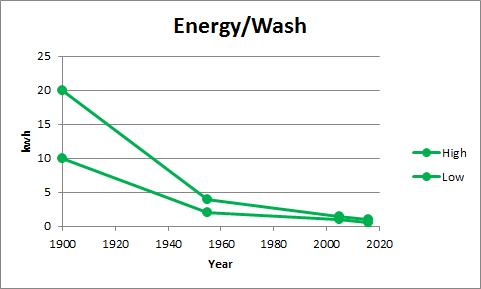
A few days ago the old washing machine collapsed under it's own weight into a heap of foul smelling rust and water, depriving a newt of a home in the process.  The new washing takes advantage of a microprocessor and advances in detergent technology and seems to consume 0.5 kwh/wash.  The trend in energy consumption is shown in the graph below.


This graph is potentially misleading as it does not take account the size of the wash.  In 1900 there would probably been one big wash on Monday, whilst a modern family might run the washing machine several times per week.  A better graph would have needed more research.
PS - To replicate Brownian motion, place an unlevelled washing machine on quarry tiles.