Pages

Showing posts with label laundry. Show all posts

Monday, 20 June 2016

Laundry and Negawatts (one more time!)

Technology has its role to play in sustainable energy systems but so too does behaviour.  I've learnt that conversations about consumption are difficult and that some of the things that facilitate the reduction of energy consumption are just not sexy.  I've made a couple of visits to "eco" fairs where there are blokes huddled up discussing panel orientation and the nature of inverters just like I and other teenagers once discussed motorbikes.  Try and bring LED lighting into the discussion and you might be like the kid with the rusty, back-firing and moped (those mopeds that have survived are now collectable and change hands for serious money).  I did mention to someone that I was measuring the energy consumption of our washing machine and from the reaction I sensed that the words "geek" and "nerd" were not far away.

Due to some dubious career advice, I left school at 15 and spent a couple of years as merchant seaman followed by some time in a factory.  The fact that I have spent much of my career writing computer software, suggests that I was not cut out for a life on the ocean wave.  Whilst I was close to incompetent, as this experience drifts further into the past, I am attempting to mine it for anything relevant.  Remuneration was not generous but included two bars of soap per week, both were brick like, one was a dark red carbolic variety which repelled both women and infestations, but as only one of which was present on the ship, this was not a problem.  The other was yellow "Port Sunlight" which was used for laundry.  Both types could be used as currency in some ports.

The laundry process (known as dhobying) consisted of placing soiled clothing in a bucket of water, rubbing it with a lump of soap and agitating it until one was either bored or the clothes were clean.  A couple of rinses in clean water and the process was almost complete.  Ships have lots of warm spaces, so getting stuff dry was not a problem.  As this was hand washing, I doubt if the temperature of the water was very high.  The standard of personal hygiene in a all male community frequently engaged in dirty work was reasonably high (with the odd exception), so who needs more than a bucket and a bar of yellow soap?

Fast forward some decades and home is a suburban semi populated by two adults and three would-be adults and a washing machine.  The latter consumed 1.0 to 2.0 kwh/wash, maybe 3 to 8 kwh per week.  Eventually, the children leave and the washing machine unable to cope with an empty nest, starts to leak, vibrate and die.  It is removed by two men who swear a lot. The replacement provided by the insurance company is in my opinion dynamically unstable and can't be left unattended.  I have agreed to perform a certain number of washes to see if the machine "settles down".  Rather than just staring at a vibrating cube, I weigh the washing before and after and measure the energy consumption.


Initially, my wife selected a programme with a 40 deg. C temperature and I duly filled and emptied the machine and drew a graph.  A typical wash requires about 0.7 kwh of electricity, which is a significant improvement on the old one.  The energy consumption is proportional to dry weight, so this maybe due to the amount of energy needed to warm the contents of the drum.  When I eventually got to study engineering at university, we were taught about experimental design, so when my wife was not looking, I dropped the temperature down to 20 deg. C, so far she has not noticed any difference but the energy consumption is now 0.3 kwh/wash.  It's emulating me and a bucket or was I emulating the washing machine but that's philosophy not engineering and I'm not qualified.  Low temperature washing will not work for greasy overalls or skid marked underpants, but not every wash contains those things.

Modern washing machines are highly energy efficient, but there is no obvious way to interact with their energy consumption.  Smart meters might help, or even a stupid meter mounted in the kitchen so that a home's energy consumption is visible.  The energy meter I use cost less than £20 and has paid for itself, so it would not be significant cost increase to incorporate energy monitoring into a washing machine or similar device.   My opinion is that most homes could drop their energy consumption by 10 - 20% without any lowering of the standard of living, if only they knew what it is.  Once we were using 5kwh/week to keep clean, now it is less than 1 kwh.


Saturday, 9 April 2016

Laundry and Energy - A Personal History

Laundry is one of the more energetic domestic chores, either for the person doing the washing of the machine to which it is delegated.    During the past few weeks the renovation of the kitchen has been a large part of my life (I desperately need to get out more).  What we now use as the kitchen used to be the scullery.  A scullery is might be described as the Victorian's idea of a utility room, there was a large coal store, storage place for food marked on the plans as "larder" and usually referred to a the pantry", a sink for washing dishes and a "copper" for washing clothes.  The copper can be seen on the plans:


The copper, possibly made of cast iron, was mounted in a brick structure, the lower section of which was a small furnace.  I've looked several house plans and as far as I can see, these things were not connected to chimneys, so the weekly wash would have been done amid smoke and carbon monoxide.  In 1900 much of the laundry work was boiling clothes and bed linen.  Boiling 5 gallons of water might require 2 kwh, but allowing for the heating a mass of brickwork and other losses, the total energy consumed might be 10 - 20 kwh or in more practical terms, a shovel full of coal.  Add to this the physical effort the laundry itself.

I'm guessing, but coppers remained in use in our family into the 1920 or 1930s.  My mother carried on boiling things into the 1960s.  This might have been a fear of disease, in her youth, there were a lot of things that could become fatal like TB, scarlet fever and measles.  Boiling would have dealt a deathblow to those microscopic lifeforms known as germs.   My early memories of Monday, the day of laundry, are centred on the "Baby Burco" which was the 1950s equivalent of the old copper, which by then was gas fired.  Clothes were extracted from this cauldron of soap and boiling water with wooden tongs.  After use, the hot water was dumped into the drain one bucket at a time, this may have been good for the drain, less so for those doing the work.  The energy uses might have been 2 - 4 kwh.

It was many years after leaving home before I encountered another Baby Burco.  This was at the back of the local greengrocer (now a Thai takeaway) where the owner used one to boil beetroot.  After the success of the Harry Potter novels, it would require only a small stretch of the imagination for a young adult to see a wizard stirring a vat of blood red potion before dispersing it to the neighbourhood through the sewers.

The Baby Burco was finally replaced by a washing machines which might be described as an electrically heated tub with an agitator, the buckets were replaced by hoses and wires, the danger of scalding decreased, but the risk of flooding increased.  I'm guessing but the energy used also decreased, but the stress levels remained high.

For quite a long time, I found better things to do with my life than measure the energy consumption of washing machines, but in 2010 I bought an energy meter.  When applied to the then current washing machine, it seemed that the device consumed roughly 1.0 - 1.5 kwh/wash including the hot water it took from the hot water cylinder.  I never, investigated the inner working of this thing but I think it heated the water from the "hot" supply if it was below a certain temperature using electricity as it's electricity consumption dropped once we fixed the hot water system.

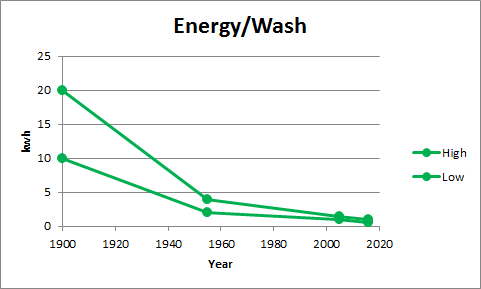
A few days ago the old washing machine collapsed under it's own weight into a heap of foul smelling rust and water, depriving a newt of a home in the process.  The new washing takes advantage of a microprocessor and advances in detergent technology and seems to consume 0.5 kwh/wash.  The trend in energy consumption is shown in the graph below.


This graph is potentially misleading as it does not take account the size of the wash.  In 1900 there would probably been one big wash on Monday, whilst a modern family might run the washing machine several times per week.  A better graph would have needed more research.
PS - To replicate Brownian motion, place an unlevelled washing machine on quarry tiles.